Why you won’t save money by producing your own eggs
Tyrant Farms' articles are created by real people with real experience. Our articles are free and supported by readers like you, which is why there are ads on our site. Please consider buying (or gifting) our books about raising ducks and raising geese. Also, when you buy through links on our site, we may earn an affiliate commission. Learn more
Let’s cut right to the chase: No, you won’t save money by producing your own eggs from backyard poultry. It’s important that intending poultry owners understand this BEFORE they decide to move forward with getting poultry or they’re likely to have unrealistic expectations and/or end up abandoning or neglecting their animals once this realization becomes apparent. You can stop reading right here if you just want a high level takeaway. However, we’d encourage you to continue reading if you’re the type of person who also wants to know the WHY behind an answer…The fluctuating costs of commodity eggs
Let’s start with a high level view of the price of conventional/commodity eggs that you’ll find at typical grocery stores. Below is a 10 year egg price index from January 2013 through January 2023, courtesy of Trading Economics, which shows the highest cost of eggs in our lifetime: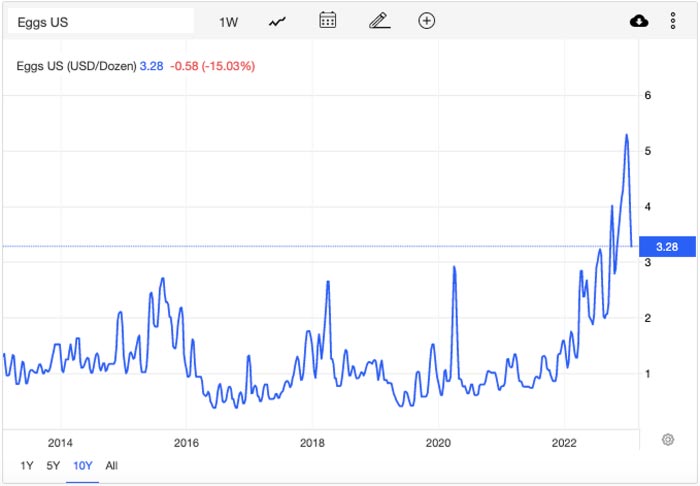
What caused the highest egg prices in a decade?
The peak egg price occurred in December, 2022. This spike was the result of a perfect storm of factors causing a massive increase in egg prices:- Inflation/higher interest rates which drive up costs everywhere and for everything;
- High seasonal demand (all those baked holiday goods take eggs!); and
- Most importantly, the worst ever outbreak of a highly pathogenic avian influenza (influenza A).
Avian influenza: the biggest factor causing egg price increases in conventional eggs
As many sources noted at the time, when 57 million chickens across 47 states die or have to be slaughtered due to avian influenza infection, the price of eggs is going to skyrocket regardless of any other pricing factors. Here, it’s also important to note that this data pertains specifically to conventional chicken eggs, not necessarily specialty eggs and/or eggs from other species like ducks. One Forbes article rightly noted: “While the cage-free requirement has kept California egg prices high, in other states that have more lax rules for egg producers, organic or cage free might actually be the cheaper option. An earnings report from Cal-Maine Foods, a top U.S. wholesale egg producer, noted conventional eggs went from $1.15 in 2021 to $2.88 in 2022 while specialty eggs (organic or cage-free) went from $1.81 in 2021 to only $2.37 in 2022.”The most expensive “cheap” egg
To illustrate a point, let’s take a worst-case scenario: specialty organic free-range egg prices (nominally comparable to the quality of eggs you might raise at home) shoot up and stay at $7/dozen over the next year. Over that time period, your family eats two cartons of eggs every week. Under this scenario, you’ll pay $728 for eggs over the next year, or $0.58 per egg. That’s a lot of money! Nevertheless, as we’ll illustrate below, this seemingly “high” price of commercial eggs (conventional or specialty) represents the cheapest, most efficient egg that could possibly be produced today. Yes, the chickens in this system generally live short, terrible lives and the pollution generated by conventional farms is socialized/paid by everyone else. Nevertheless, conventional egg production is a low margin, well-oiled machine that gets cheaper, more efficient, and more automated every single year.Why your backyard eggs will be more expensive than store bought eggs
When you get backyard chickens or ducks, you’ll likely only get a dozen or fewer animals, not hundreds or thousands. That means they’ll cost much more per “unit” up front. From there, you’ll have to:- Buy or build a brooder system to raise chicks or ducklings (and an incubator if you want to hatch your own)- assuming you don’t purchase mature birds.
- Pay for high priced feed and other supplements because you’re only buying a few pounds at a time from a retailer, and it’s likely (hopefully?) to be much higher quality than what’s given to poultry at a factory farm.
- Pay for and construct a decent coop and possibly a run, unless you want your poultry and eggs eaten by other animals.
- Maintain fresh bedding in your coop (and possibly run), which isn’t free.
- Incur expensive bills from a specialized avian vet when/if your animals get sick or injured beyond what you can treat at home (unless you cull them).
- Plan for decreased egg production the older your birds get (unless you cull them).
- Pay for a poultry sitter any time you want to leave town or go on a trip.(Unless you have a very generous and trustworthy friend or family member to fill in.)
- Dedicate countless hours and labor every year, which has a monetary value whether or not you recognize or account for it.
Artificial light to maximize egg production
Finally, commercial/production poultry are given artificial light to keep them hormonally able to produce the maximum number of eggs possible over their short lifespans. Once the animals reach the age of slower egg production, they’re culled. However, backyard egg producers like us ( and hopefully you) want our animals to “turn off” egg production as daylight hours decrease during the cold months in order to:- remineralize their bones;
- be as healthy as possible for as long as possible;
- produce the most nutritious eggs possible during the laying seasons.
No, we’re not virtuous, we’re impractical
Does any of this make us virtuous and the commercial operations “evil”? We don’t think so. We simply operate in completely different paradigms with completely different goals in mind. Our aim is not to produce the cheapest possible egg or to save money. Rather, our aim is to optimize our *family’s health and happiness while operating regeneratively on the small patch of earth that we presently have control over. (*Yes, our ducks are part of our family.) As long as lots of people demand the cheapest possible eggs produced by someone else, there will be commercial entities vying to produce the cheapest possible eggs. It’s a self-reinforcing feedback loop with both positive and negative outputs and tradeoffs. More and cheaper food for more people? Good, sort of. Food that isn’t very healthy and that causes enormous levels of animal suffering and environmental degradation? Not good. We don’t like it, but that’s the world the vast majority of people seem to want. Maybe raising ducks and raising awareness about these issues is a way that we (and you) can create small ripples of change while maintaining our sanity. Move over, goat yoga. Backyard duck therapy is here.Are ducks better than chickens for avian flu?
Since avian flu often wreaks havoc on both commercial and backyard chickens around the country, it’s worth noting that ducks are much better suited to deal with avian flu than chickens are.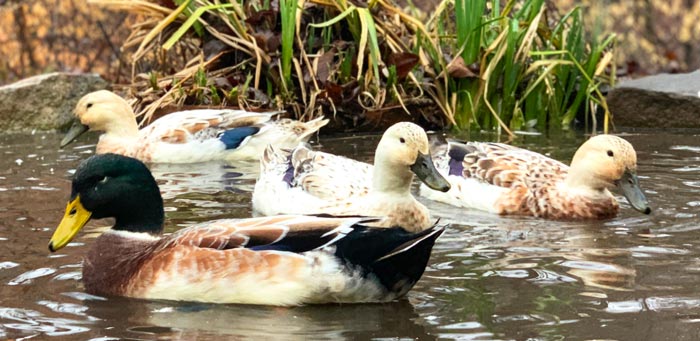
- Viruses constantly mutate so it’s always possible that novel forms of avian flu will wreak havoc on ducks.
- An infected duck may be unharmed and asymptomatic, but it can still carry and transmit avian influenza to other birds (and possibly to humans).So be warned if you keep both chickens and ducks together!
So how much does it cost to produce a backyard egg?
If you accurately account for your time, labor, and hard costs, the chicken or duck eggs you produce at home are likely going to cost 2-4 times more per egg than what you’ll find at a grocery store — especially if you’re giving them top quality feed, lots of outdoor time, healthy treats, etc. And if you ever have to take your poultry to an avian vet, any cost comparison analysis you conduct will be depressing. Annualized over the past 10 years, each duck egg we’ve produced likely costs in the range of $2/egg. If anything, that’s a conservative estimate. That’s nearly 4x higher than the most expensive possible egg you could get from the store ($0.58) detailed above.Thankfully for our ducks, they’re not here to save us money on eggs. Rather, they’re highly entertaining family pets who help control garden pests while producing fertilizer for our plants. As a side benefit, they also happen to produce food for us during certain times of the year. Even if you won’t save money by producing your own backyard eggs, should you still consider getting backyard chickens or ducks? The answer depends on your goals and resources. For us, the answer has and will continue to be “yes.” Raising ducks doesn’t make cents, but it does make sense. (Looks like we did bury the lede, after all!) A quick but relevant aside… We’ve written all about the reasons we think duck eggs are better than chicken eggs and why ducks can be better animals than chickens for backyard poultry enthusiasts, so we’re not going to rehash that here. -Aaron & Susan

Flap on over to these other backyard duck articles:
- Beginner’s guide to raising ducks
- 10 things you should know before you get ducks
- Duck eggs vs chicken eggs
- A fowl comparison: backyard ducks vs chickens
- How to raise ducklings, a step-by-step guide
- How to build a long-lasting predator-proof duck coop and duck run