How to find and use juniper berries from Eastern red cedar trees
Tyrant Farms' articles are created by real people with real experience. Our articles are free and supported by readers like you, which is why there are ads on our site. Please consider buying (or gifting) our books about raising ducks and raising geese. Also, when you buy through links on our site, we may earn an affiliate commission. Learn more
Watch our video about foraging juniper berries on our YouTube channel, Untamed Eats. You can also Download our 1-sheet printable juniper berry foraging guide.
Juniper or cedar tree?
If you live in the eastern half of North America, chances are there are Eastern red cedar trees (Juniperus virginiana) near you. Confusingly, despite their common name, this is NOT a true cedar. It’s a species of juniper.
The name confusion came about when early European settlers noticed that Juniperus virginiana trees looked very similar to true cedars growing in certain areas of Europe. The misnomer stuck even though the later scientific classification accurately placed the tree in the juniper family.
Juniper berries from Eastern red cedar
One of the nice things about Eastern red cedars is that they produce cedar “berries” which are edible for humans and wildlife alike. These aren’t true berries they’re actual a cone with tiny edible seeds inside.
So to make sure you’re thoroughly confused: Eastern red cedar trees aren’t cedars and they produce juniper berries which are cones not berries. Ha.
Are juniper berries from other juniper and cedar species edible?
There are countless species of juniper and cedar trees around the world – and quite a few species in North America as well. Not all of them produce edible berries. In fact, some of them produce poisonous berries (examples: Savin junipers and Rocky Mountain junipers).
Important: Never eat something that looks like a juniper berry unless you’re positive of the species and edibility. (More on that below.)
What do juniper berries taste like?
Juniper berries have an intense flavor like a cross between pine trees and citrus rinds with a hint of blueberry flavor on the front. They’re definitely not something you want to eat by the handful like blueberries, but they make a wonderful flavoring or spice.
Now, before you go eating any wild food, including juniper berries, you should:
- be 100% certain you know how to correctly identify it, and
- know and heed any safety warnings.
Let’s dive into those topics so you can safely start using juniper berries in your kitchen!
How to identify juniper berries from Eastern red cedar trees
Here’s how to identify juniper berries from Eastern red cedar trees:
1. Range – Eastern red cedars generally grow in the eastern half of the United States. See range map:
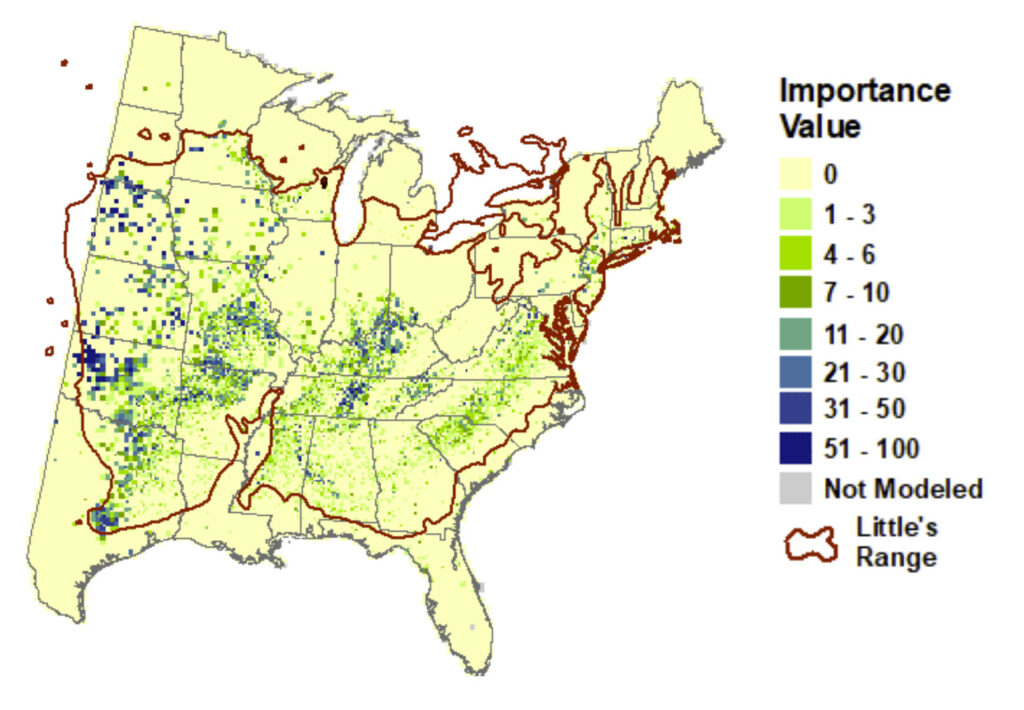
2. Ecological function / position – Eastern red cedars tend to be on the edges of forests or even living as standalone trees in open fields. You won’t find them deep inside a mature forest. This is because they’re primarily a pioneer species in ecological succession, despite the fact that they can live to be hundreds of years old.
3. Fruiting season – Juniper berries (cones) on female trees ripen from fall through winter. Male trees don’t make berries.
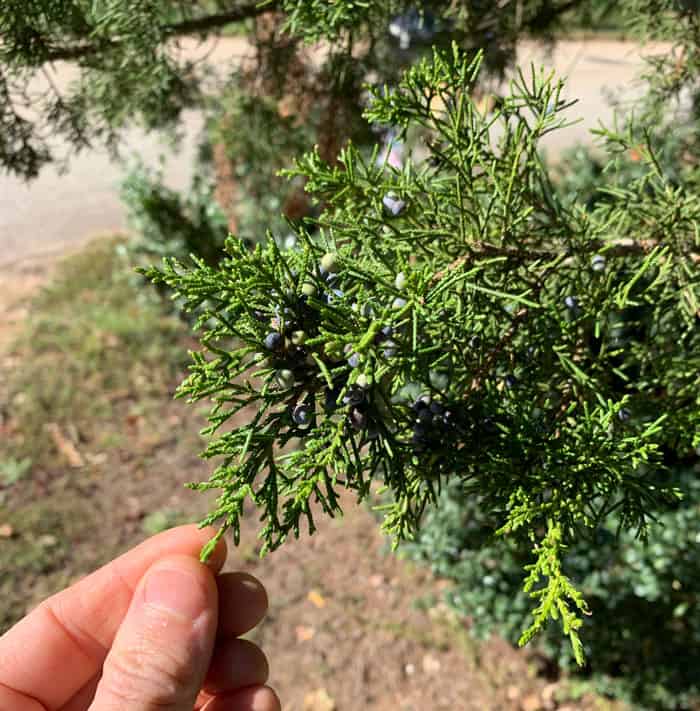
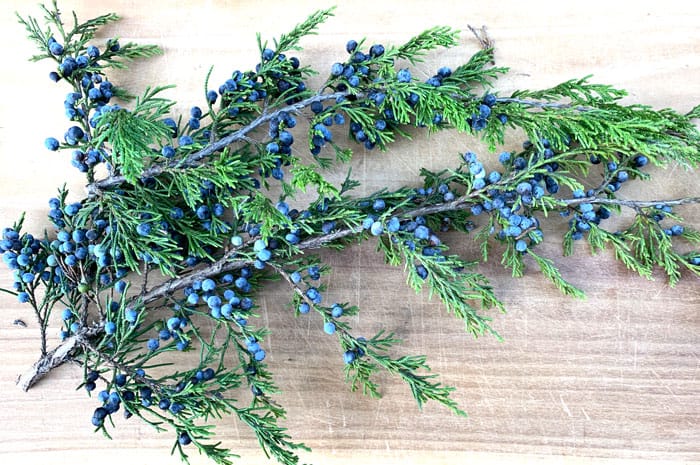
4. Berry features – When ripe, juniper berries are about the size of peppercorns and have a blue, dusty color.
5. Growth habit – When they’re mature enough to fruit and have enough sun, Eastern red cedar trees are typically quite tall (up to 60′). They’re never mounding or crawling.
Eastern red cedars don’t tend to have a distinct shape. We’ve seen some that are Christmas-tree shaped and others that are more round.
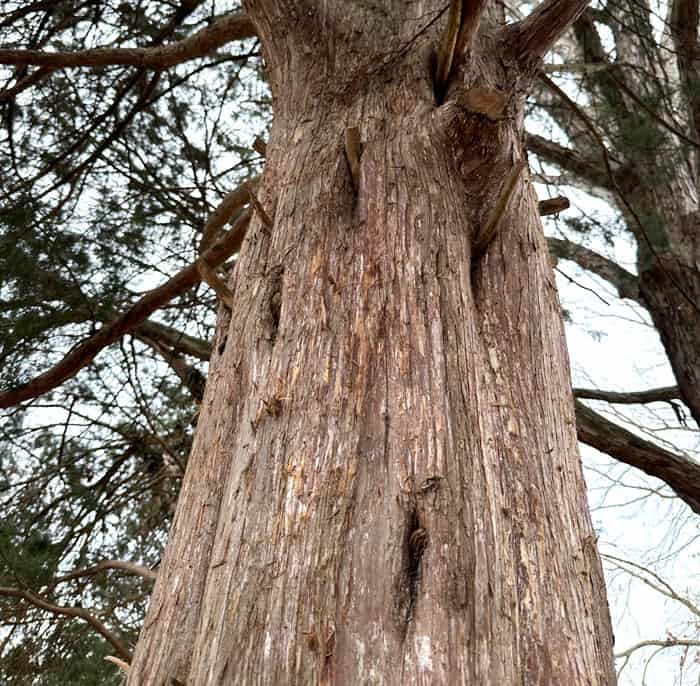
6. Bark – Eastern red cedars feature distinctive shaggy, reddish-brown bark.
7. Leaves – Their scale-like, aromatic needles are prickly to the touch and look like tiny braided ropes. They’re also a coniferous evergreen, so they’ll stay green throughout the cold months.
Juniper berry warnings
There is scant scientific research on the safety of consuming juniper berries from Eastern red cedars. Most juniper berry research is focused on the species of juniper berries commonly used in other countries, such as Juniperus communis, which is used to flavor gin.
Easter red cedar juniper berries have been used for thousands of years by Native Americans as both food and medicine, and the berries are widely used for culinary purposes today. In the small amounts in which they’re consumed, they’re considered safe.
Out of an abundance of caution, some sources warn pregnant or breastfeeding women against consuming juniper berries even at culinary doses due to their potential to stimulate uterine contractions and cross the placenta or enter breastmilk, with potential negative effects on developing kidneys. Again, these concerns are not based on documented cases or research trials, only concern about possible negative effects.
Poisonous lookalikes
Within the native range of Eastern red cedars (see range map earlier in article), there are no other native poisonous lookalikes that produce small blue berries. However, you might stumble across a non-native, non-edible lookalike evergreen in a commercial landscape such as the Savin juniper, which produces blue berries but has a mounding, crawling growth habit.
Thus, foraging juniper berries from Eastern red cedar trees in the eastern half of the United States is a pretty low-risk activity.
Using juniper berries in your kitchen:
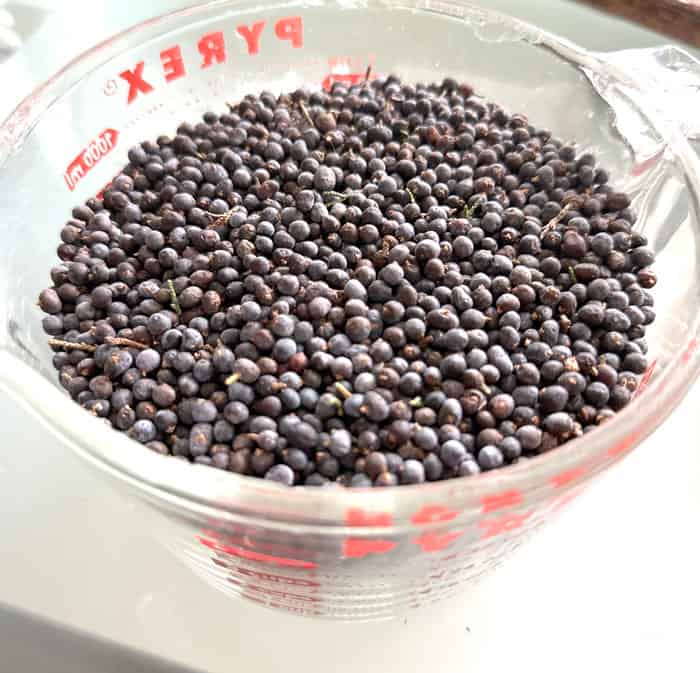
First, know that you can easily dry juniper berries for long-term use by simply leaving them on a plate indoors for a couple weeks. Once dried store them in an airtight container for later use.
We use juniper berries to add flavor to sauerkraut and pickles and as part of a spice rub for meat. They also add a nice flavor to baked apple dishes (apple pie, apple butter, etc). Remember, it doesn’t take many juniper berries to add flavor so experiment on the volume used per recipe to dial in on your flavor preferences.
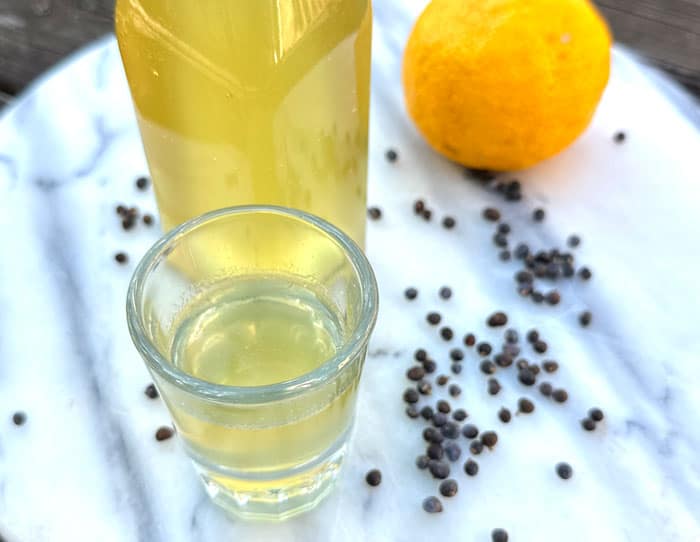
What’s our favorite juniper berry recipe? Check out our Juniper berry-yuzu-honey wild-fermented cordial recipe!
Happy and safe foraging!
-Aaron and Susan