
How to prevent or treat egg binding
Tyrant Farms' articles are created by real people with real experience. Our articles are free and supported by readers like you, which is why there are ads on our site. Please consider buying (or gifting) our books about raising ducks and raising geese. Also, when you buy through links on our site, we may earn an affiliate commission. Learn more
If your ducks (or other poultry) are laying soft eggs or having other reproductive problems like being egg bound, making them go broody may be a life-saving intervention. In this article, we’ll show you exactly how to make a duck go broody.
In one of our interviews with top avian vet, Dr. Scott Echols, DVM, DABVP (Avian Practice) he aptly describes in very human terms the toll that laying hundreds of eggs each year can have on a duck:
“Imagine you’re a human woman and you’re having a child every nine months since the time of your first period.”
Not surprisingly then, reproductive health problems (and other downstream health problems) are a very common issue that pet and backyard duck parents will have to deal with. Here, we’ll help you figure out what to do if your ducks start laying soft-shelled eggs and/or becoming egg bound.
The short answer? Make them go “broody.”

What does “broody” mean?
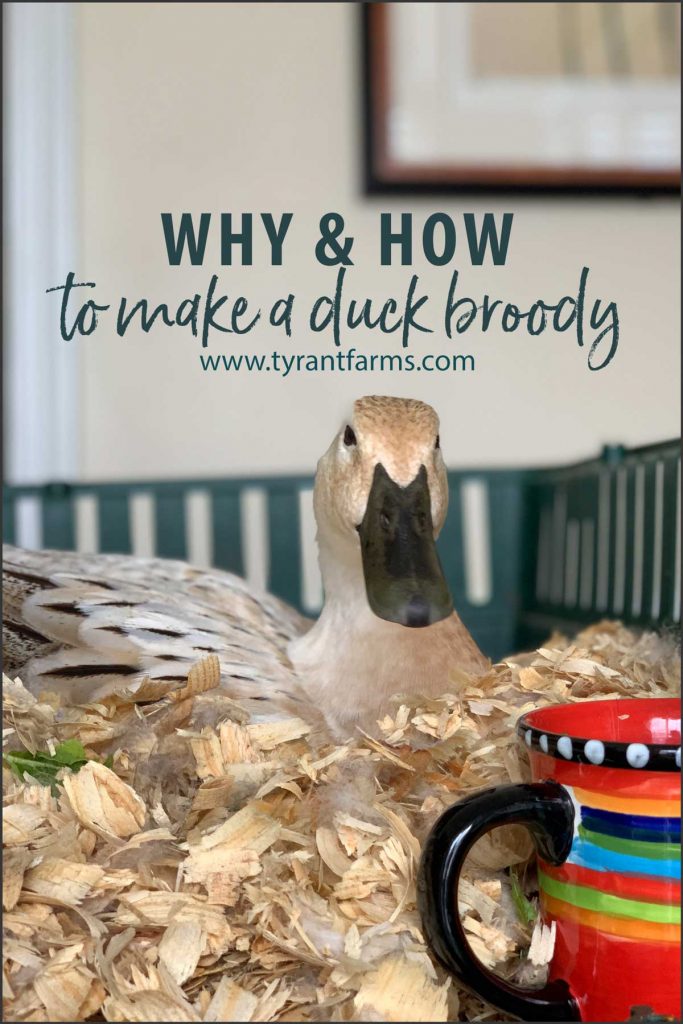
In case you’re new to poultry language, a broody duck is a duck that is entering the stage in their reproductive cycle where they sit on their eggs and nest. This stage also corresponds with hormonal and physiological changes.
A broody duck becomes very defensive of their nest. Even an extremely tame duck will open her mouth (so scary – ha!) and fluff her feathers in defense against her favorite humans. This is why the term broody made its way into common vocabulary as a way to describe a moody or grumpy human.

A broody duck will also reduce food and water intake, and even begin holding their poops until they’re off their nest. This instinct decreases potential pathogen exposure to their ducklings and decreases the likelihood of predators finding them or their eggs via scent in the wild.
Now, if you know ducks, you know how un-ducklike those last behaviors mentioned are. Non-broody ducks don’t sit in one spot all day, and they sure as heck won’t voluntarily restrict their food intake or outtake. After all, they’re basically feathered pigs.
Perhaps the most important thing that a fully broody duck does: stops laying eggs. The cessation of egg production is caused by the release of the hormone prolactin.
Why make a duck go broody?
Here are a few reasons why we’ve made ducks go broody over the years — and why you might want to as well:
1. You want your duck to hatch eggs in order to raise ducklings. Obviously, you’ve got to have fertilized eggs for this scenario to work, so you’d need a drake to be part of this equation as well.
2. Your duck is laying soft or thin-shelled eggs or has suddenly stopped passing eggs and become lethargic. (When trying to pass soft-shelled eggs, ducks will often sit with their tail down and/or slowly pump their tails.)
3. You have a duck who has been laying eggs daily for a long time and you want her to stop laying BEFORE she starts having potential health problems.

What is egg binding?
Egg-binding is a condition that happens in ducks and other poultry wherein an egg gets stuck in the reproductive tract. This can cause other eggs to back up. In severe cases, the eggs can rupture inside the duck causing infection and death.
Egg-binding is a serious, painful, potentially life-threatening medical condition for a duck. The severity of the case determines the optimal treatment, and minor surgery may even be necessary. For new/inexperienced duck parents, we’d advise taking your egg bound duck to an avian vet immediately.
Thankfully, it’s been many years since we’ve had an egg bound duck (knock on wood). However, we have effectively dealt with egg-binding twice.
Once, we gave the duck an anti-inflammatory drug then put her in a warm bathtub. After an hour, she was calm and relaxed enough to pass the eggs.
Another time, The Tyrant had to put on lubricated surgical gloves and do some gentle “exploring.” You can use your imagination here, but the eggs soon emerged. (Way to put your Biology degree to good use, dear!)
In both instances, after getting the eggs out, we immediately set out to make our ducks go broody in order to halt egg production so we didn’t have a repeat incident — or worse.
Another essential step when dealing with an egg bound duck or a duck who is laying soft eggs is to boost their calcium intake immediately, even though potential calcium deficiency is likely a symptom of the problem, not the upstream cause. We gave our eggbound ducks 2ml of calcium gluconate (you can buy this online if not locally) twice per day orally, once in the morning, once at night. Once they go broody, you can stop giving them calcium gluconate.
Don’t worry, orally medicating a duck isn’t hard once you get the hang of it, but you can kill your duck if you inject fluids down their glottis. So, please read our article and watch our instructional video first if you don’t know how to orally medicate a duck!
How to make a duck go broody
Thankfully, making a duck go broody is a pretty simple process, even though some of your more spirited ducks will find it very irritating.
Step 1.
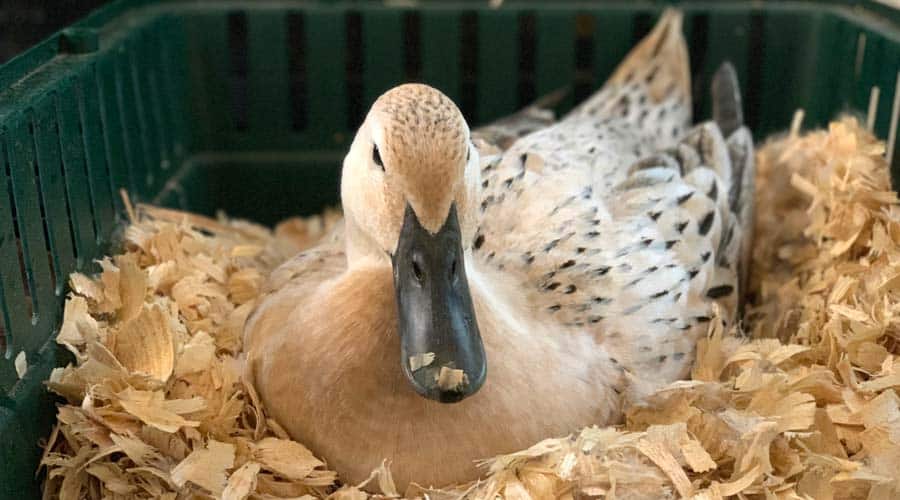
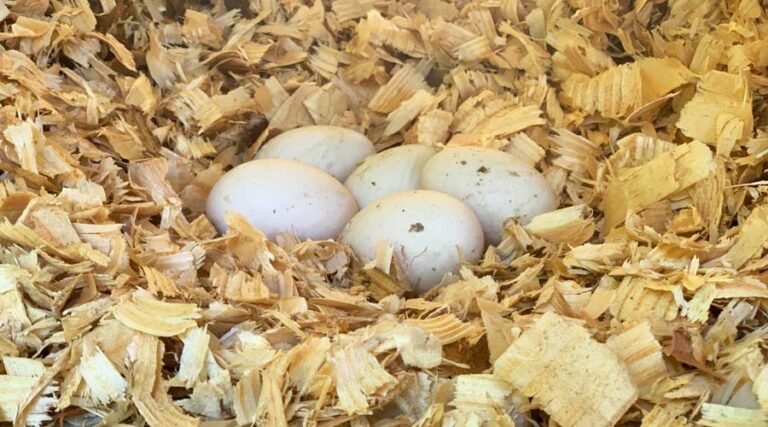
In a shady/dark and safe environment, set up a nest for your duck. We use an animal carrier with pine or Aspen shavings shaped into a nest, and put the crate inside our house so we can keep a close eye on things.
Initially, the crate has a door and top on it, but these can be removed once the duck becomes broody because she won’t want to leave her nest.
Step 2.
Place ~6 eggs in the nest. This is trickier than it sounds…
If you place unfertilized eggs in the nest they can end up going bad after a couple weeks underneath a warm, damp duck. If you place fertilized eggs in the nest and you’re not intending to hatch ducklings, you could end up with unwanted ducklings.
Our recommendation? Use fake eggs. They’re lighter than real eggs, so you can tell the difference — but your duck can’t. That way, you can remove any real eggs from the nest as things progress.
Step 3.
Insert one duck. That’s not an instruction you see often!
Keep the crate closed so she can’t come off the nest, but provide a small water and food dish. (Once broody, they’ll only need a water dish with some greens and other treats in it (like tomatoes), and can be fed their regular food when they’re off the nest.)
Step 4.
Wait for broodiness. It can take anywhere from a few days to a week to make your duck go broody. Several times each day, you’ll want to take the crate (with duck inside) outside to let your duck get some sun, exercise, and time cleaning herself in the water.
Why take the crate outside with duck still inside? Remember the thing we said about broody ducks not pooping? Well, when you remove a broody duck from her nest, you’ll have about 30-60 seconds before the poop explosion comes. Trust us that you do not want to have this happen indoors if you can avoid it.
Step 5.
Tempting though it may be, do NOT pet and touch your duck (or at least do so as little as possible) while she’s in the process of going broody — especially on her “sexy regions” (top of head, back of neck, and back). Being touched will incline your duck to stay in sexually active/egg laying mode hormonally, rather than transitioning to broody mode.
Once your duck goes broody, you can return to normal levels of physical affection.

How will you know when your duck is broody?
Once you’ve had a broody duck, you’ll know the signs:
- They’ll want to stay on their nest and will try to get back to their nest shortly after being removed.
- They won’t poop on or near the nest unless they just can’t hold it any longer.
- They’ll fluff up and pretend to be scary when you come near the nest (and may open their bills at you which is oh-so scary!).
- They also have a really funny, sad/agitated sounding mwah-mwah-mwah broody call they make when they’re removed from their nest.

How long should you keep a sick duck on their nest once they’re broody?
Once our sick ducks have gone broody, we’ll usually keep them in their indoor crate for an additional 3-4 weeks. This simulates how long it would take their eggs to incubate and hatch under normal conditions.
Your duck will lose some weight over this time period and will likely pluck out some of her chest feathers to add as nesting material. This is perfectly normal.

How long does it take a duck to stop being broody?
At the end of this process, we’ll put the broody duck back outside with their flock. They’ll make agitated sounds and be grumpy for the first day or so, but will usually stop being broody within about 48 hours.
Within the next month, they’ll also have a molt, aka lose and replace their feathers.

Based on our experience, it seems to take at least two months or so for our ducks to start laying eggs again, although this will likely vary by breed, age, and season. For instance, if you make your duck go broody in the fall or early winter, she probably won’t lay again until the following spring due to the relationship between sunlight and hormones.Whereas a duck that goes broody in early spring will likely start laying again in the summer.
Regardless, this process gets your ducks to stop laying eggs and gives their bodies time to heal, remineralize, and return to optimal health. This may well be a life-saving intervention that’s important to have under your belt if and when needed.
What about Deslorelin implants?
Deslorelin is a hormone implant which can quickly shut off egg production in ducks and other avian species in as little as a few days. Some avian vets will use this in an emergency, but it’s generally not a good idea. Why?
For one, in our video interviews with Dr. Echols, he notes that it is technically illegal under FDA regulations for vets to give Deslorelin implants to ducks since they are considered food/production animals not companion animals. In other words, a vet could lose their license.
Second, Dr. Echols details problems he’s seen in ducks and other fowl given a Deslorelin implant: it doesn’t always work; the effects sometimes wear off quickly; the rapid effects can cause eggs to get stuck, infected and have to be surgically removed, etc. In his opinion, Deslorelin is not a great remedy for an eggbound duck, and there are more effective ways to both shut off egg production in a duck and lower their annual egg production while keeping them in optimal health.
We hope the information in this article helps you become a better and more informed duck parent!
Quack on,


Dabble in some of our other helpful duck articles:
- How to make a self-cleaning backyard duck pond
- 17 tips to keep your ducks or chickens safe from predators
- Duck health guide: first aid kit, essentials, and other tips
- 5 tips to keep your ducks from destroying your yard or garden
- What to feed pet and backyard ducks to maximize their health and longevity



Hi Tyrant Farms!
After 3 years of problem-free egg-laying, my Welsh Harlequin (Olive) has been laying soft-shelled eggs rather frequently since last year. She now lays about 2-3 normal eggs in a row, then skips a day or two, and then lays 2 eggs on the same day, one of which has no shell. My ducks get a very healthy diet (duck pellets, fresh veggies and a bit of fruit every day, with mealworms sprinkled around for foraging) and have constant source of clean water (pond and several water dispensers). Olive is the only problematic duck. I’ve tried everything I’ve seen online regarding additional food supplements (crushed egg shells, Nutri-Drench, kelp, yeast, etc.), but the soft-shelled eggs keep coming. As you point out in your article, I’m very worried about egg-binding.
I’ve tried to follow the steps of your article about how to make a duck go broody. Olive lays her eggs in a little “dog house” that I built when she was just a duckling. I thought this would be the best place to “lock her up” by blocking the opening with a piece of wire fence. I’ve placed the fake eggs you recommended inside and she has access to fresh water and a bit of food. I still let her out 3 times per day for 30-60 minutes to bathe and to stretch her wings.
Unfortunately, she refuses to go broody. She keeps quacking for 4 hours per day (2-6pm) and is very restless when she is inside the little house. If she gets too anxious, I cover the wire fence with a piece of cloth, so she doesn’t see the other ducks roaming around and get jealous.
I don’t have a drake, only females of different breeds. Is a drake needed to go broody? She does “mate” with her best (girl)friend duck sometimes. Do you have any suggestions? Should I keep locking her up if she still hasn’t gone broody after a week?
I’m looking forward to hearing your advice.
Thanks!
Hi Dennis! First, so sorry for our slow response. We’ve been negligent checking comments lately. Also, sorry to hear about Olive.
We’ve been keeping ducks over a decade and can say this: individual ducks from the same breed of the same age eating the same food and living in the same environment can have different egg laying dynamics. For instance, we have a 10-year-old Welsh Harlequin named Pippa who still lays eggs and is as spry as she was during her first year. She has sister Welsh Harlequins hatched the same week that have stopped laying eggs and entered what we jokingly call “henopause.” One of Pippa’s sisters had so many issues laying that she experienced ovarian damage during her fourth year which caused her to stop producing the hormones necessary to express female secondary sex characteristics, so she now looks and acts like a drake. (She was born Mary but we now call her Marty.)
All that to say that it sounds like you’re doing everything right, you just have a duck who has the genetic or epigenetic misfortune of not being a good long-term layer. Some people in your situation would try to get their vets to prescribe a Deslorelin / Suprelorin hormonal implant which would immediately shut down her egg production (at least for several months). However, that approach isn’t an ideal long-term fix and it’s also technically illegal for vets to prescribe to production poultry. Unfortunately, if you want to keep Olive alive for many years to come, you’re just going to have to treat her differently than your others ducks. Being forced to sit on a clutch of eggs in a dark spot in the spring will eventually get her to go broody, but it sounds like she’s going to fight you on that one. Other considerations: is her loud quacking from being locked in a dog house going to drive you or your neighbors crazy?
You also might want to significantly curtail her protein intake since that macronutrient helps trigger reproduction. No mealworms and consider putting her on Maintenance feed rather than Layer feed. We have a partition in our coop so that we can give our girls who are NOT laying maintenance feed while giving our girls who are laying slightly higher protein rations (anywhere from 25-50% layer to 75-50% maintenance depending on where we are, seasonally). You may also consider during oral injections with a liquid calcium supplement like calcium gluconate, but we’d only advise doing that under the administration of an avian vet because calcium supplementation and uptake is very tricky and dynamic in poultry. Wish we had a silver bullet answer for you, but some ducks are just going to be tricky if your goal is optimizing healthspan and lifespan. Obviously, commercial operations don’t have to worry about such thing since their birds are culled every 18-24 months.
Hope this info helps and best of luck to you and Olive!
Our Pekin, Susan, was our only duck who laid eggs all winter long and it really took a toll on her with soft shelled eggs, etc. I finally have convinced her to “adopt” a pair of ceramic eggs and she has been lovingly tending them for a few weeks now. She’s not the best mother, so for example was out for several hours in the yard with her friends but then hopped right back on the nest when she came back into the run.
Do you think there would be any harm in letting her sit on them for longer than a month, especially if she is sort of half-hearted about it? I’d love for her to get as long of a break as possible from egg laying.
Thanks!
Great question, Kate! The risk with extending Susan the duck’s broodiness would be that she correspondingly reduces her food intake over a longer time period. Broody ducks tend to severely reduce their food intake, which is a normal physiological/hormonal response necessary to incubate eggs and protect their nest. In your case, if Susan has gone broody and shut off egg production but is otherwise eating normally, you’ll have the best case scenario to help her body remineralize and rebound. However, if she’s eating less than normal, you might want to maintain a normal broody schedule of ~1 month rather than trying to extend it. Also, note that even when a domestic duck snaps out of broodiness, it can still take many weeks or months for them to start laying again, depending on a wide range of factors.
Thanks! I think we are going to keep going with it… she was out in the yard foraging for several hours today then hopped back onto the nest when I put her in. Interestingly, she has had a spot of bumblefoot that I have been trying to treat for months and months with very slow progress. I looked at it today for the first time in a few weeks after honestly doing nothing to it (we’ve had some other animal issues taking up our time) and it’s pretty much healed! I think her body was really stressed.
Glad to hear things are going well, Kate! The vast majority of our ducks’ bumblefoot infections are mild, ergo not severe enough for us to treat. We’ve found that healthy ducks can easily fend off most bumblefoot infections. We’ve also noticed the same thing as you: our ducks get more bumblefoot infections and those infections take longer to heal when they’re laying eggs. Also, as best we know, our drake has never had so much as a mild bumblefoot infection. Our conclusion based on these observations is that laying so many eggs over so long a time period (which doesn’t happen in wild ducks) takes an enormous amount of energy and bodily resources, thus making such ducks more susceptible to infection and illness. Since our ducks are also pets, this is a primary reason we don’t aim for maximum egg production; we instead aim for optimal health and longevity.
Two possibly useful resources for you and/or other readers:
1. How to safely and humanely treat bumblefoot in ducks: https://www.tyrantfarms.com/how-to-treat-bumblefoot-in-ducks-safely-effectively-and-humanely-with-video/
2. What to feed backyard ducks to maximize their health and longevity: https://www.tyrantfarms.com/what-to-feed-pet-or-backyard-ducks-to-maximize-their-health-and-longevity/
Hi, I have 2 hen ducks who finally started laying, and I want at least one of them to go broody in March-April. Since it’s February I don’t want them to brood yet, but I never collected about 5 days worth of eggs, and in the corner of the coop they’re all organized neatly in what looks like a clutch. No down or anything, though, just the eggs sitting there. If one of them is already trying to go broody, can I take the eggs thus breaking the broodiness and still have her go broody in a month?
Hi Bob! Yes, removing the eggs from the nest now under the circumstances you’ve described would prevent your duck from going broody.
how long do you wait before letting her out of cage. my welsh harlequin has laid daily in a beautiful nest she built in our duck house but just drops the egg and stays outside day and night. we just pulled all but 12 eggs and locked her in alone the cage. you mentioned dont touch them but we normally have ro chase her and physically put her in the cage. how l9ng should we leave her in before we let her out for sun water and pooping?
Hi! I’ll try to clarify things a bit to answer your questions:
1. Assuming your duck is not already broody (it sounds like your girl isn’t), it may take 3-7 days of being caged on a nest for your duck to go broody. We recommend using fake eggs, but you can use real eggs if that’s easier for you.
2. Initially, you should provide both food and water in the cage next to her nest. You should also let her out 2-3 times per day for sunlight, swims, etc. You’ll have to touch your duck to catch her, put her in her cage, etc. However, we recommend keeping physical contact to a minimum at this point (don’t pet them) otherwise you can delay or prevent them from going broody.
3. Once she goes broody, you’ll know it. That’s because she won’t want to come off of her nest and her behavior will change. Even her voice will change a bit. From there, you’ll still need to remove her 2-3 times per day for sunlight, exercise, swim, etc.
4. Pay close attention to the number of eggs. She should stop laying eggs within a few days of going broody.
5. How long you wait from the day she stops laying until the day you remove her from her nest to put her back outside is somewhat subjective. We usually wait about 30 days from start to finish to mimic a natural brooding cycle, but you don’t have to wait that long.
Hope this answers your questions, but let me know if you need anything else!
Fascinating, educating and thoroughly enjoyable advice on how to get ducks to get broody. Found it whilst trying to find advice on the opposite problem!
We have 2 Khaki Campbell’s which have both laid at one time or another, but never for more than about 3-4 months. In fact, one has only laid for a couple of 2 month periods. They’re now approaching 2 years old, have a 20 ft pond, surrounded by grass, and a choice of nesting areas and shelters. They’re fed layers mash, with treats of fish pellets (love ’em!) and lettuce leaves.
If you’ve had reason to write any advice on LOW egg production, I’d really appreciate a steer on how to find it. Khaki Campbells are supposed to be pretty prolific, aren’t they?
All the very best,
Hayden
Hi Hayden! That’s a very odd scenario you’ve described.
Yes, Khaki Campbells are considered excellent egg layers. In our article about duck breed comparisons (https://www.tyrantfarms.com/how-to-choose-the-best-duck-breed-or-breeds-for-you/) we detail that they can lay up to 240 eggs/year with a laying score of 8.5 out of 10. The only breeds we know of that have the potential to be more prolific layers are Golden 300, Hybrid Layer, and White Layer.
It sounds like you’re feeding your Khakis for maximum egg production. The only three possibilities we can think of that would cause lower egg production under the circumstances you’ve described are:
1) Low light levels. Are your ducks in a shady spot for most of the day? Just to clarify, seasonal sunlight fluctuations affect egg production. Ducks need at least 14 hours of daylight to produce eggs, but if they’re in a spot that’s shady, they might not be getting the light stimulation they need for egg production. Just for clarity, this does NOT mean ducks should be forced to live in full blazing sun during the hot months – they should always have shady spots to retreat to if they desire.
2. Hiding eggs. Is it possible your ducks have a really good hiding spot for their eggs? You’d probably notice this by the awful smell produced once the eggs went bad at some point, but it’s worth considering. Our ducks can be quite sneaky when it comes to hiding eggs – especially when they lay outside their coops.
3. Breeding. Did you get your ducks from a source like Metzer Farms or somewhere else? Big breeders tend to breed with egg production in mind, whereas a local/backyard breeder might not.
Hope this helps narrow down a cause of your low egg production!
Hi! I’m hoping you’ll have some advice regarding our Khaki Campbell. She has laid an egg every day for over 18 months. She seems perfectly healthy and the eggs are still normal (hard-shelled, no deformity, etc), but her last two molts have been incomplete, presumably because she doesn’t stop laying during them. She only has new feathers on about half of her body and the older feathers have lost their waterproofing, so she no longer bathes/swims. I would really love to halt her egg-laying so she can do a complete molt and rest her body, but I worry that the broodiness won’t take due to her being a Khaki Campbell. From what I’ve read, they almost never display any maternal behavior. Do you think it’s worth trying or have any suggestions for alternatives? Thanks for your time!
Hi Emily! Yikes, 18 months straight of egg laying is a lot of stress and strain on a little duck body.
Years back, we had a similar situation with a duck and it ended up causing ovarian damage, so she no longer lays eggs. Odd as it sounds, this caused her body to stop producing female hormones (the default sex in ducks is male) so she now displays secondary sex characteristics of a drake, e.g. she looks like a boy duck. (If you’re interested you can read details here: https://www.tyrantfarms.com/can-birds-change-sex-the-curious-story-of-mary-marty-the-duck/)
Now, I’m not saying any of that is going to happen to your duck, only that laying eggs for that duration takes a LOT out of them and can cause damage to their reproductive system in addition to a wide range of other health problems, some of which you’re starting to experience. So you definitely want to get her to stop laying eggs asap in order to molt, remineralize, and recover.
We only know of two ways to make a duck stop laying eggs:
1) Make them go broody, as we detail in this article.
2) Get an avian vet to do a deslorelin implant (the brand name medication vets use is Suprelorin).
Making a duck go broody can be a pain for all involved, but it’s free and doesn’t require a hormonal injection. A deslorelin implant is going to likely run you at least a couple hundred dollars, but it’s fast-acting and guaranteed to shut down your duck’s reproductive processes within 1-2 weeks. She’ll be molting shortly thereafter. (We’ve taken this route a couple times over the years.) The implant is a good option if you’re stretched for time and/or have a duck who refuses to go broody.
If you’re wondering what the heck deslorelin is, it’s a synthetic gonadotropin-releasing hormone (GnRH) agonist deslorelin acetate. Non-jargon: it’s a synthetic version of a hormone birds/ducks naturally make, and the continuous, high-dose presence of the hormone (via the implant) quickly shuts down the processes that lead to reproduction/egg laying. The effects of a deslorelin implant will last for 4-8 months, depending on the implant your vet uses. Either timespan should hopefully be enough for recovery and remineralization, assuming they have good nutrition, time in the sun, etc.
Not sure of your exact circumstances, but you could always try to make your duck go broody (example: give it two weeks of effort) and then if things just aren’t going as hoped/planned, you could opt for the implant. Either way, since your duck has been laying non-stop for 18 months and is beginning to display outward signs of health issues, you want to get moving on it as soon as you’re able to.
Best of luck and please keep us posted on how things go, for our sake and the sake of other readers!