
Should you wash your eggs?
Tyrant Farms' articles are created by real people with real experience. Our articles are free and supported by readers like you, which is why there are ads on our site. Please consider buying (or gifting) our books about raising ducks and raising geese. Also, when you buy through links on our site, we may earn an affiliate commission. Learn more
Should you wash your eggs? Whether you’re a backyard poultry enthusiast, a small farmer/poultry breeder, or a market shopper, you might wonder when, if, or why you need to wash your eggs. You’ll find the answers in this article!
In case you’ve never been here before, we’d like to start with a bit of introductory context… We raise heritage breed ducks as pets and egg producers for our family.
Over the years, we’ve eaten many thousands of freshly laid duck eggs, and we’ve never once gotten sick.
You’ve likely eaten countless eggs in your lifetime as well, and you’ve probably never gotten sick from them. This despite the fact that ALL eggs are laid by poultry who poop in close proximity to their eggs and are covered in various microbial species, some of which are pathogenic to humans such as Salmonella.
Why have we never gotten sick? Because we understand the risks of eating fresh eggs and take necessary steps to mitigate those risks (which we’ll discuss below). The same thing is true for why you’ve probably never gotten sick from eating grocery store eggs, although in that situation your good fortune is due to laws/regulations that farmers have to follow in order to keep the food supply safe.
Now, let’s take a deeper dive into when, if, or why you should wash your eggs and detail some basic egg anatomy for context.
Eggs sold commercially in the United States have been washed/sanitized
If you buy commercially produced eggs anywhere in the United States, those eggs have been thoroughly washed as per USDA Code § 590.510. These eggs are usually produced in large operations and washed via specialized equipment to meet government regulations such as § 590.515:
(2) The temperature of the wash water shall be maintained at 90 °F or higher, and shall be at least 20 °F warmer than the temperature of the eggs to be washed. These temperature shall be maintained throughout the cleaning cycle. (3) An approved cleaning compound shall be used in the wash water.”
These and other regulations mean that your eggs have been thoroughly cleaned so as to remove microbial contaminants on the surface of the egg. This seems like a pretty basic and reasonable standard.
Many other developed countries don’t require egg washing
So why do many other countries in the developed world not require commercial producers to wash eggs intended for public consumption? In markets throughout Asia and Europe, you can even find unwashed eggs on display at room temperature — not in the refrigerated section. Egads!
Is this because non-Americans are resistant to Salmonella and other pathogens? Or because they’re unclean barbarians? Nope, it’s because there are viable — and safe — alternatives to our ultra-hygienic approach to egg production.
This may come as a shock, but chickens, ducks, quail, geese, and other fowl don’t make eggs for humans to eat, they make them so they can successfully reproduce. Thus, an egg contains everything a developing bird needs to survive, including the “bloom”, a protective layer coating the egg shell to keep bacteria and other pathogens out…
Step-by-step: follow an egg through the reproductive tract
Each fowl species has a highly specialized reproductive tract that works like a miniature egg production factory. At peak production, a chicken, duck, or other fowl can produce up to one egg every 24 hours.
Egg production starts in the ovary where the yolk is made. From there it goes to the infundibulum to be fertilized by a male’s sperm. Even if the yolk isn’t fertilized at this point, it continues down the reproductive “assembly line.”
Now the fertilized or unfertilized yolk heads to the magnum, where the egg white (albumen) formation begins. The egg white provides some anti-microbial defenses, but its primary functions are:
- to keep the yolk centered in the egg for proper avian embryonic development;
- to provide additional nutrition and water for the embryo (albumen is 88% water and 12% protein).
After the magnum, the egg heads down the oviduct to the isthmus. Here’s where the thin inner and outer shell membranes are created (this is the thin papery layer you see on the inside of dried cracked open egg shells).
The next stop on the egg’s journey is the uterus, where it will remain for about 20 hours while the hard outer shell is produced. An egg shell is actually a semipermeable breathable membrane made of calcium carbonate crystals.
The last step of the journey: the egg goes through the bird’s vagina and out the cloaca/vent. This last step may not seem important but it’s absolutely critical to egg health, poultry reproductive success, and — coincidentally — humans eating eggs without getting sick.
As the egg goes through the poultry vagina it gets coated with a microbial force field of sorts. This force field is called the bloom or cuticle.
What is an egg bloom or cuticle? As a study in World’s Poultry Science Journey summarized it:
“The cuticle is the outermost layer, deposited on the palisade layer of the eggshell during the last 1.5-2 hr of eggshell formation in utero. It is a non-calcified, thin, water-insoluble layer composed mainly of glycoproteins with some carbohydrate and fat constituents. The cuticle functions as a protective layer which regulates gaseous exchange across the shell, acts as a first line of defence against microbial penetration across the eggshell and is associated with termination of calcite crystal growth during shell formation. The extent of cuticle deposition is influenced by hen age and strain.”
The egg’s bloom/cuticle is why many other countries are able to safely sell unwashed eggs at room temperature without everyone who eats them getting sick. In short: it keeps what’s inside the egg from getting infected from what’s outside the egg, which also happens to make the egg safe for you to eat.
Once you wash an egg in warm soapy water, the bloom is removed (the bloom feels slightly slimy when washing by hand) and the egg is now defenseless against pathogen contamination from the outside. Thus, without refrigeration a de-bloomed egg is no longer safe to eat.
Like most everything in nature, the bloom is not perfect, it’s simply good enough. That means the entire egg and the 17,000 microscopic pores on the shell may not be 100% covered with bloom. Or perhaps the egg contacted poo inside the coop before the bloom had a chance to dry, thereby negating its defensive properties. But generally speaking, the bloom is good enough to allow for birds to reproduce and you to safely eat their eggs.
When should you wash your eggs?
Now you know how an egg is produced via the poultry reproductive system and how an egg’s bloom protects the egg (and you) from pathogen contamination.
So when should you wash your eggs?
The answer to that question is context-dependent. If you’re in the United States or another country that requires egg producers/farmers to wash their eggs, you don’t need to wash your store bought eggs before eating them.
If you somehow find poo on your store-bought egg that made it through commercial washing, you should dispose of the egg rather than eating it. That’s because at least part of the bloom on the egg was likely washed off and bacteria from the poop could easily have made its way into the egg causing contamination.
Should you wash duck eggs before incubating them for hatching?
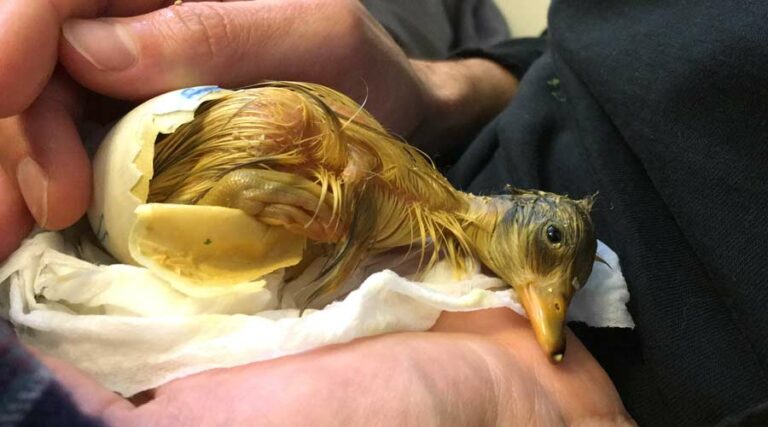
If you’re planning to hatch eggs, you do NOT want to wash your eggs prior to incubation. Removing the bloom will significantly increase the risk of termination of the developing embryo inside due to bacterial infection.
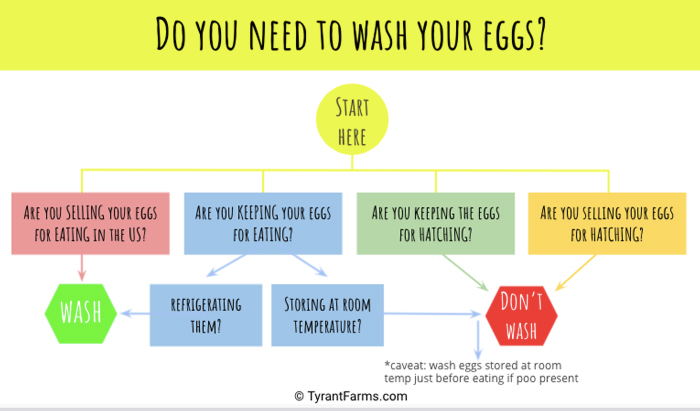
As for other circumstances as to when or if you should wash your eggs, the flowchart below provides the answer for most situations:
Do we wash our duck eggs?
In case you’re wondering whether or not we wash our duck eggs, the answer is it depends.
If we’re not already overrun in eggs and we plan to eat the eggs within a week or so, we don’t wash them. In that case, we store them at room temperature in a container on our kitchen counter.
If the eggs are soiled and/or we might not be able to eat them soon, we wash them in warm soapy water before putting them in the fridge. This eliminates the risk of the eggs contaminating other items in the fridge.
If you wash your duck eggs, we recommend you do the following:
- Wash each egg individually by hand rather than soaking or re-using the same cleaning water.
- Use warm (not scalding hot) soapy water.
- Dry, date, and refrigerate the eggs. After drying, we use a pencil to write the lay date on the bottom of each egg, then put them in the fridge. We try to keep the eggs in dated order in our fridge, but just in case things get mixed up, we can always look at the date on the shell to make sure we’re not eating an old egg.
Another hygiene tip: it’s a good idea to have a designated egg cleaning scrubber and not use the same cleaning tools on your dishes that you do on your eggs. Also, if you have lots of eggs each day or you’re planning to be a small-scale commercial producer, you can look into specialized automated egg cleaning devices to meet your needs rather than hand washing them.
How long will duck eggs last?
Unwashed, unrefrigerated duck eggs will last at least 2 weeks indoors at room temperature, and up to 3 months if refrigerated. Washed, refrigerated duck eggs will last for 5 weeks or longer. If in doubt, use the float test to make sure an egg is still good.

*Warning: The CDC recommends you only use pasteurized eggs for raw egg recipes.
We hope this article answers all your questions about when, if, and why you should clean your eggs! If not, please feel free to leave us a comment below and we’ll do our best to answer your questions.
KIGI,

~Aaron and Susan
Flap on over to these related articles:
- Duck eggs vs chicken eggs: how do they compare?
- Complete guide: How to hatch duck eggs
- How to raise ducklings, step-by-step guide
… and other duck articles from Tyrant Farms.





Thank you for the thorough article on egg washing!
I have two, ten month old Pekin girls that are sporadically laying eggs. We get about 5 eggs a week. Other websites said to wash the eggs with warm water only. I see you use warm, soapy water What kind of soap do you use for the “soapy water?” Thanks!
Hi Laura! When washing our duck eggs, we use whatever dish soap we have next to the sink, which is usually Dr. Bronner’s or Seventh Generation.