
How to sex ducks & ducklings: male vs female
Tyrant Farms' articles are created by real people with real experience. Our articles are free and supported by readers like you, which is why there are ads on our site. Please consider buying (or gifting) our books about raising ducks and raising geese. Also, when you buy through links on our site, we may earn an affiliate commission. Learn more
There are lots of reasons you may want to know whether you’ve got male or female ducks or ducklings. In this article, you’ll find out how to sex ducks, regardless of breed or age!
Use the table of contents below to jump right to the section you’re interested in or read the whole article for a deeper dive.
Table of contents:
- Part 1: What does “sexing a duck” mean and why is it important?
- Part 2: How to sex MATURE ducks
- Part 3: How to sex DUCKLINGS
- Part 4: Duck sexing frequently asked questions
How to sex ducks and ducklings
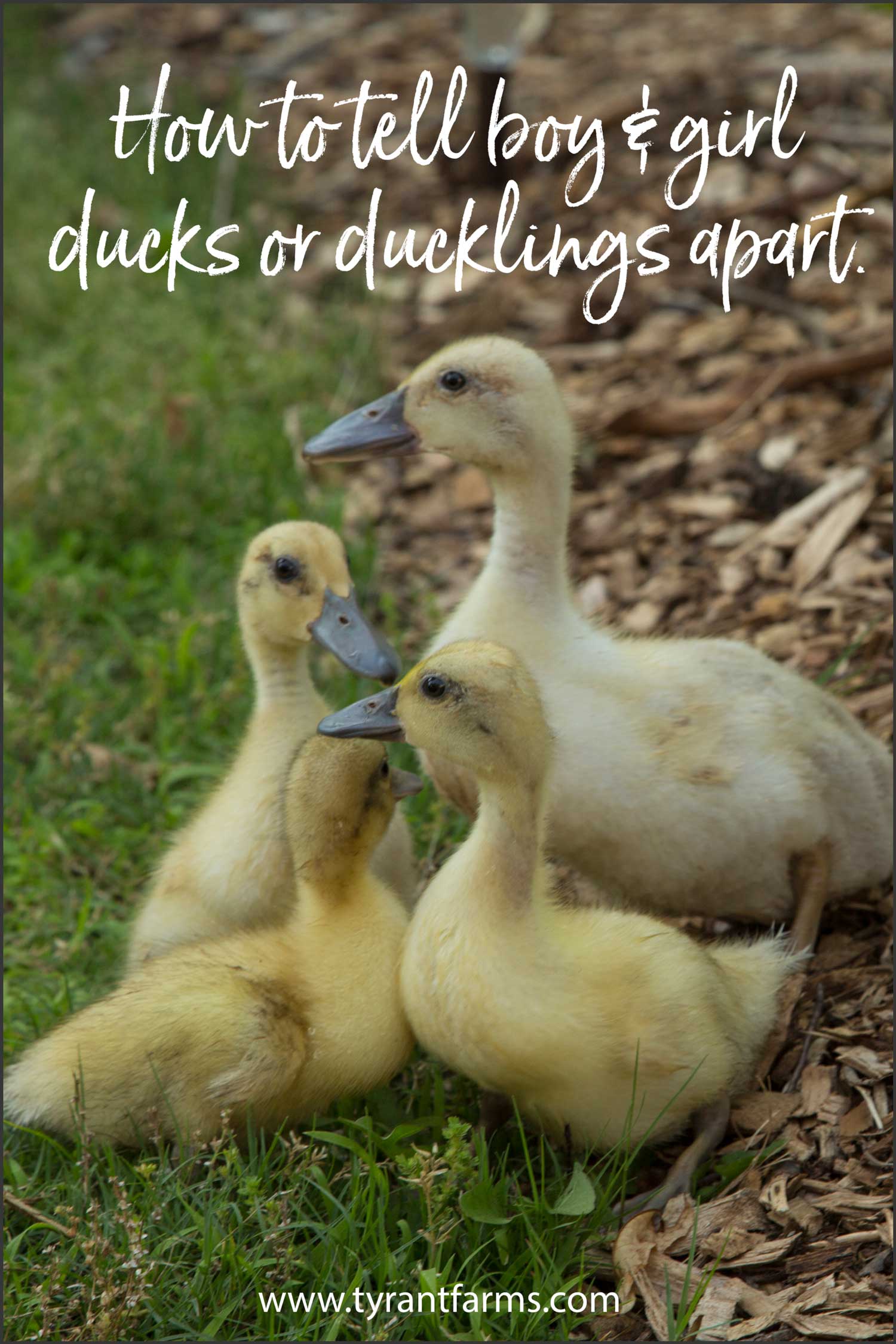
Sexing refers to various methods employed to distinguish male versus female ducklings or ducks.
Knowing he sex of a duck is a very important factor for anyone considering raising ducklings or adopting mature ducks. That’s because mixed-sex flocks can be much more difficult to manage, leading to more fights, over-mating, injuries, and other problems.
If you buy a sexed run from a professional breeder, they do the sexing for you so you don’t necessarily need to know this information (although they do sometimes make mistakes!). However, if you’re hatching eggs or picking out your own ducklings or mature ducks, knowing how to sex them can be critically important.
(See: Should you get male or female ducks or both?)
So how do you tell the difference between male and female ducks regardless of age and breed?
How to sex MATURE ducks
Let’s start with the easy part: sexing 6+ week old ducks:
Method 1. Vocalization check
If you’ve ever raised ducklings, you know they mature incredibly quickly. In fact, they look like miniature adults after about 6-8 weeks. At that point, you can start to tell the difference between male and female ducks using your ears.
That’s because real duck men don’t quack. Instead, drakes make more of a low, raspy blurp-blurp-blurp sound that a human ear might mistake for some strange species of frog. A drake could talk as loud as it wanted in your backyard and would likely be unable to let your neighbors in on the conversation — unless you have particularly nosy neighbors.
Only female ducks make the distinctive (and loud) duck vocalizations that you think of with ducks: quack-quack-quack. Granted they actually have a far more varied and nuanced vocabulary than “quack.” When a female duck wants to be heard, your neighbors will know about it.
Vocalizations are an easy way to sex either:
a) Young 6-10 week old ducks in dimorphic breeds who haven’t yet earned their distinctive adult plumage. (dimorphic means the males look different from the females), or
b) Monomorphic breeds like American Pekins who have nearly identical plumage regardless of their sex.
(*Watch the video “Duckling vocalizations: 12 Days old to 6 weeks old” in our How to raise ducklings guide.)
Method 2: Plumage and other physical features
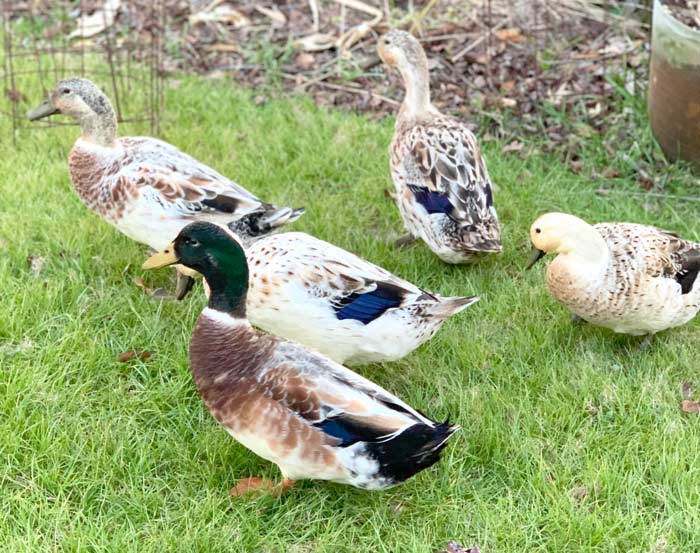
A. Feather coloration – For older, mature ducks with dimorphic plumage, the easiest way to immediately sex them is to look at their feathers. Drakes of most Mallard-derived breeds have gorgeous green-iridescent head plumage for a large part of the year (aka nuptial plumage), until they go into their eclipse plumage at which point they look far less showy.
Female ducks within these breeds do not have green heads. However, for other breeds like Pekins (which are all-white), this distinction does not help in sexing.
(Learn more about duck plumage and molting patterns.)
B. Drake feathers – While in their nuptial plumage, drakes also have “drake feathers,” a few curled feathers on the top side of their tail.
Female ducks do not have curly drake feathers on the tops of their tails.
C. Other physical features – Some breeds (like Welsh Harlequins) also have other physical differences at maturity. For instance, our Welsh Harlequin drake has bright orange legs and a yellow/orange bill, whereas our female Welsh Harlequins’ legs are more dark grey/green in color as are their bills. However, these physical distinctions are not universal to all breeds of ducks.
Using the distinctions detailed above (vocalizations, plumage check, & other breed-specific sex differences), you should be able to easily sex a duck that’s 6+ weeks old. If you’re trying to sex a monomorphic breed, there won’t be a green head to go by, but the voice/vocalizations and possibly the drake feather (if they’re in nuptial plumage) will indicate their sex.
How to sex ducklings
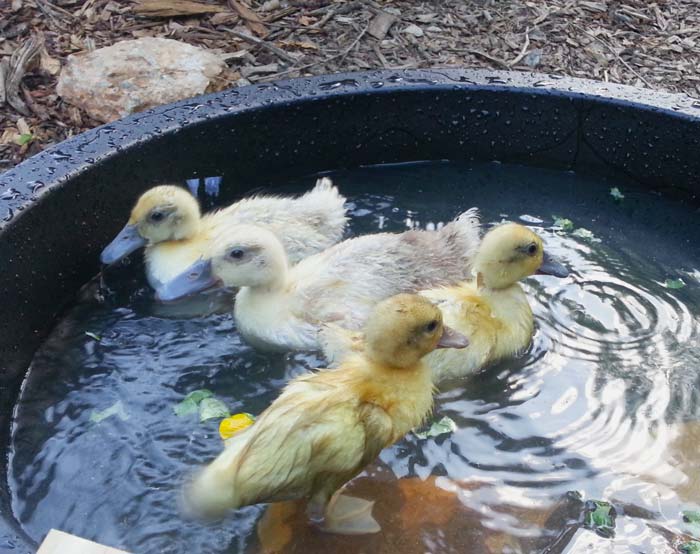
Now comes the harder challenge: sexing those adorable little duckling fuzzballs that all look nearly identical.
There are three methods used to sex ducklings, but only vent sexing provides a definitive determination:
Method 1: Down coloration
In some duck breeds, there are subtle differences in down coloration between male and female ducklings. There are too many breeds and too much variability (or lack of variability) to list here. Plus, this method is not going to help you definitely sex ducklings, so we’ll only give a casual mention to this method here.
Method 2: bill coloration
There can be differences in bill coloration in ducklings of certain breeds. For instance, if a very young Welsh Harlequin duckling (days 1-3), has a pinkish colored bill with a dark tip, it’s likely a female. A darker bill likely means male. However, this method is not definitive and only applies to one breed of duck, so doesn’t provide much in the way of universal help.
Method 3: vent sexing
Again, the only 100% definitive way to sex ducklings of any breed is by vent sexing, also called “vent checking.” However, it’s critical that you know how to do vent sexing safely and correctly before you give it a try. And vent sexing is best done on 1-2 day old ducklings — after that, it’s more difficult.
Warning: You can permanently injure your ducklings with improper vent sexing. Before we dive into the how-to’s of vent sexing, we need to issue a very clear warning. If a vent check is done incorrectly with too much force or for too long a duration, you can permanently injure your ducklings. Those little duckling parts are quite delicate!
Thus, if you don’t know how to conduct a proper vent check, please do not proceed. Let an expert — such as an avian vet — conduct a vent check for you and possibly teach you how to do it for future reference.
Vent sexing instructional video
There are also excellent online instructional videos about how to sex ducklings. We’d highly recommend watching this Metzer Farms’ video about vent checking before you consider doing the procedure yourself:
*For reference, Metzer Farms sexes tens of thousands of ducklings per year, so they likely have more experience sexing ducklings than anyone else out there.
How to vent sex ducklings:
In addition to the information we provide below, there are also excellent online instructional videos about how to vent sex ducklings. We’d highly recommend watching expert videos before you consider doing the procedure yourself since text on a page can only take you so far. Metzer Farms has an excellent vent sexing video you can search for on YouTube.
Now, let’s dive in! (Perhaps not the best turn of phrase in this instance.)
A duck’s anal vent, aka cloaca, is where their reproductive organs reside. However, in ducks/ducklings, neither the male penis nor the female vagina is visible with a mere surface inspection. Hence the need for a deeper look…
When doing vent sexing, you’re NOT trying to pop the [potential] drake’s penis out by pushing on the area around the vent. Instead, holding the duckling upside down in one hand, use the fingers of your other hand to gently pull back (not pushing or applying pressure) on either side of the vent in order to open the vent and expose the reproductive organs below.
Tip: Your first time out, this process may be easier with two people — one to securely hold the duckling, the other to do the penis hunting (ha!).
If you spot a drake penis (which looks like a small, light-colored worm), you’ve got a male. No penis? You have a female. Occasionally, you may also find a duckling with ambiguous genitalia.
When vent sexing a bunch of ducklings, you should end up with about a 50/50 ratio of males to females. If not, you’ve likely not been very accurate your first time around. If so, don’t feel bad – it takes practice to get really good at vent sexing.
Duck sexing frequently asked questions
Now you know how to sex male and female ducklings and ducks, regardless of their age or breed! Here are a few more followup questions we’re often asked:
1.How do you keep track of male vs female ducklings after you’ve sexed them?
If you want to keep track of your male and female ducklings after sexing them, you can either:
a) Immediately separate them into different sex-specific flocks, or
b) Keep both sexes together, but place a zip tie (not too tight) around the ankles of one of the sexes, clipping off the excess tie.
Warning: If you use zip ties, you have to pay very careful attention as the ducklings’ ankles grow so you don’t end up cutting into the skin with the ties. Remove and replace zip ties as your ducklings grow.
2. Sex vs gender: what’s the difference?
Sex refers to reproductive organs. Gender refers to sexual identification, e.g. primarily a function of the brain. Confusingly, these terms are often used interchangeably even though they’re quite different, biologically speaking.
We, and many other backyard poultry owners we’ve spoken with, have had curious and humorous situations wherein their female ducks and chickens seemingly start to look and act like males.
For instance, one of our Welsh Harlequin ducks, Mary (who we now jokingly call Marty), even has the secondary sex characteristics of a drake: green head during nuptial plumage, orange feet, and curled drake tail feathers.
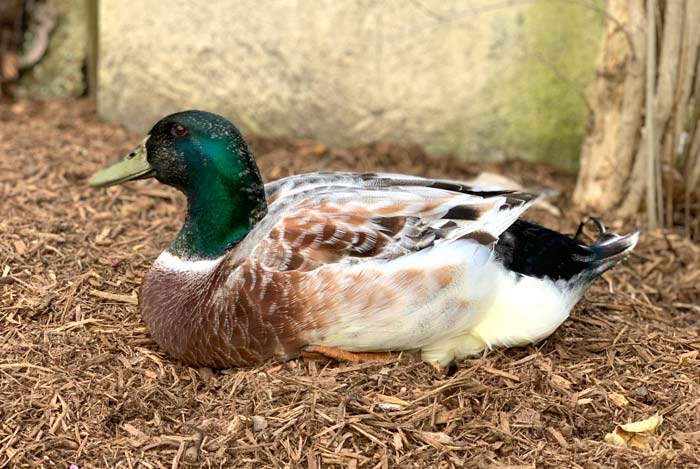
What’s the cause of this phenomenon? Turns out due to prolific egg laying in years past, Mary/Marty experienced ovarian damage. With non-functioning ovaries, her body stopped producing the hormones that made her female, so she started to revert to the default sex in ducks/birds, which is male. (For reference, the default sex in mammals is female.)
Mary’s sex is female, based on her reproductive organs and chromosomes. What’s her gender? We have no idea because she’s a duck with a relatively simple brain architecture — and she’s not saying. Her flock doesn’t seem to care, but she and our drakes tend to get in a lot of scuffles, thus requiring physical separation via fencing. As of the time of this writing, Mary/Marty is now eight years old. She’s looked like a male and hasn’t laid eggs in four years, so her condition does not seem to be impacting her longevity.
See: Can ducks change sex? The curious story of Mary/Marty the duck
Thankfully, when it comes to sexing ducks (or ducklings), most cases aren’t nearly as difficult as Mary/Marty, as you’ve learned from this article!
Want to see a video summary of this article? Check out our Google web story, how to sex ducks and ducklings!
KIGI,


Get quacking on other helpful duck articles:
- How to build a self-cleaning duck pond
- 17 tips to keep your ducks safe from predators
- How to build a long-lasting predator-proof duck coop and duck run
- How to choose the best duck breeds for you (with breed rankings)
- Understanding duck mating and courtship
- How to hatch duck eggs: complete guide
- What to feed pet or backyard ducks to maximize their health and longevity
… and more helpful duck articles from Tyrant Farms.

Hello! I’m pretty new at duck life. I started out with 2 Pekin and 2 Rouen. Now I have 1 female Pekin, 1 female Rouen and 1 Drake Rouen. Do I have to worry about the Drake Rouen mating with the Pekin? I’m not opposed to having ducklings I just don’t know about the genetic dangers, if any, of cross breeding.
Thank you for sharing your knowledge through all your articles! I have been scouring them lately and I’m excited to spoil my ducks. We are just finishing the basic stages of our pond. I’m looking forward to spring to continue its progression.
Hi Arielle! Welcome to your (almost) new ducky life. 🙂
With a 2:1 female-to-male ratio, your chief concern is likely going to be over-mating. The absolute minimum f:m ratio we recommend in a flock is 3:1. Typical over-mating injuries include: 1) injuries to the back of the head where ducks grab hold when they’re mating, 2) damaged and poor quality feathers on their backs, and 3) foot and leg injuries.
Since: a) Rouens and Pekins are both large breeds that are naturally more susceptible to foot/leg injuries than smaller breeds, and b) they’re not floating in a pond while mating, then foot/leg injuries are an elevated risk for your flock.
As far as we know, there aren’t any elevated risks or genetic concerns in crossing the two breeds. It would be akin to crossing a Golden Retriever with a German Shepherd. You may end up with some interesting feather color combinations though!
To reduce the risks of over-mating, you have multiple options: 1) get more females, 2) finish building out your pond so your ducks aren’t standing and supporting the weight of another duck while mating, 3) keep your drake physically separated from your females for most of the day during the months when he’s in full mate-mode. (Drakes typically calm down due to hormonal shifts during fall-winter due to decreases in light levels and other environmental cues.)
Hope this helps and good luck!
Hi! I’m Jude and i’m a kid but i do truly love ducks. is it possible that the 2 female ducklings i ordered from Metzer are actually boys?
Hi Jude. It is technically possible that Metzer Farms sent you two males instead of two females but it’s VERY unlikely. They’re quite good and experienced at sexing ducklings. We’ve always had 100% sexing accuracy with our Metzer ducks. Is there something happening that makes you think yours are males?
well, my 6 week old welsh harlequin is developing orange feet and she doesn’t have a black beak yet.
Metzer doesn’t necessarily breed ducks for breed standard, and a secondary sex characteristic such as orange feet in a juvenile doesn’t necessarily indicate the sex of the duck. One thing that will be a dead giveaway for sexing your ducks at 6-8 weeks is the voice. You should be getting some proto-quacks from your ducks if they’re females. The males don’t make the stereotypical duck quacking sound, they sound more raspy and almost frog-like in their vocalizations. Are you hearing the beginnings of quacks in your ducks yet?
YES!!! but they dont sound anything like male quack. thank you guys for your attentive looking at comments! You guys are so kind and you helped me SO MUCH with my sweet little ducky girls! God bless you!
Glad to hear that, Jude! You’re very welcome. Reach out any time you need duck help. 🙂
Hello and thanks for the post, I have a mixed flock of ducks (Rouen , pekin, welsh harlequins and Ancona). We have 2 Ancona and 1 Rouen who are quacking (and I swear the other Rouen was quacking but stopped). All the rest aren’t quacking but don’t sound like the males noise either. They are roughly 7-8 weeks old. Is it possible that they may just develop slower than others or am I unlucky enough to have 7/9 ducks end up being males? One pekin has a drake feather, other one not quite yet, 2 harlequins are completely different colours and can’t tell from feathering. They sound more like they have wheezy peeps still but not that low raspy male sound
Hi Miranda! That transitional period is a tough age in which to accurately sex ducklings/ducks. Unfortunately, the only thing you can do at this point (without risking injuring them) is to wait and see. Yes, it is a roll of the dice when you hatch duck eggs or don’t get a sexed run, and some times things don’t come out in your favor. For instance, the very first ducklings we picked out years ago turned out to be 3 males and one female. That’s why it’s often a good idea to order sexed runs unless you actually want to have multiple drakes for some reason (breeding, meat production, etc). Doing so requires separate caged runs and either separate coops or partitions within a coop otherwise they’ll really start going after each other if you have females around to prompt competition for mates. Best of luck!
thanks so much now i know my duckling is male your the best Kevin
Glad you were able to sex your duck!
Thanks for the article on sexing ducklings. I have not yet jumped into the pond with ducks yet !
I currently raise heritage turkeys and chickens.
I am working towards a small flock of ducks, and while doing my due diligence came upon your site with the article on your bio filtration pond.
I cannot wait for warm weather – so I can start on the pond.
I will definitely be following your site.
Thanks again!
Kevin
Thanks for leaving a note, Kevin! Best of luck in your duck raising ventures, and reach out any time we can be of help. We’re sure looking forward to warmer weather, too.