Summer Care for Ducks
Tyrant Farms' articles are created by real people with real experience. Our articles are free and supported by readers like you, which is why there are ads on our site. Please consider buying (or gifting) our books about raising ducks and raising geese. Also, when you buy through links on our site, we may earn an affiliate commission. Learn more
Use these ten duck summer care tips as a checklist to make sure your backyard (or small farm) ducks are well cared for during extreme summer heat.We (and our ducks) live in Greenville, South Carolina, a state known for sweltering summers and mild winters. During the summer, we sometimes go for months on end with high temperatures of 90°F or higher. Due to our humid climate, the feel-like is often at or above 100°F. These are not conditions in which you say, “I should put on a down jacket and spend the day outdoors.” However, that’s exactly what our ducks do in the summer. That means we have to take certain precautions in order to make sure our ducks are ready to take on the summer heat and continue thriving. Even if you’re a duck parent who lives in a cooler climate region, you should take the recommendations outlined in this article into consideration — especially during heat waves.
10 summer care tips for ducks
Use these ten duck summer care tips as a checklist to make sure your backyard (or small farm) ducks are well cared for during extreme summer heat:1. Provide good overall care – a healthier duck is a more resilient duck.
The healthier your ducks are, the more likely they are to endure hot weather. You have no control over factors like your ducks’ age or whatever conditions they’ve had since hatching — factors that can make a duck more likely to succumb to hot weather.
- good waterfowl-specific diet — and one that focuses on long-term health, not just maximizing short-term egg production;
- plenty of outdoor time to play and forage;
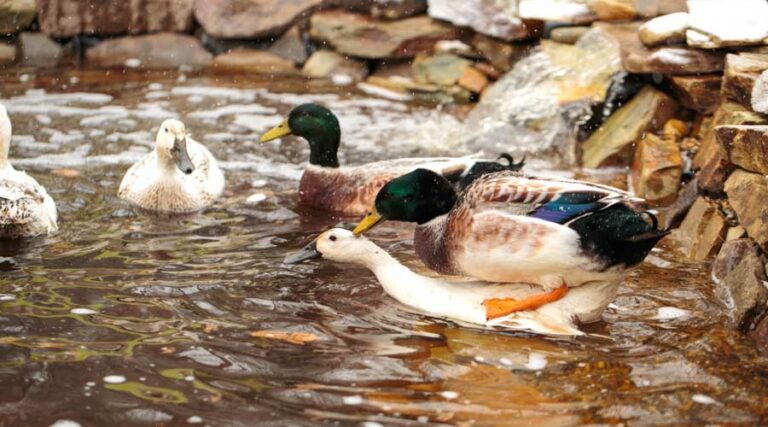
- a place to swim whenever they want/need to;
- companionship with other ducks.
2. Access to shade every hour of the day.
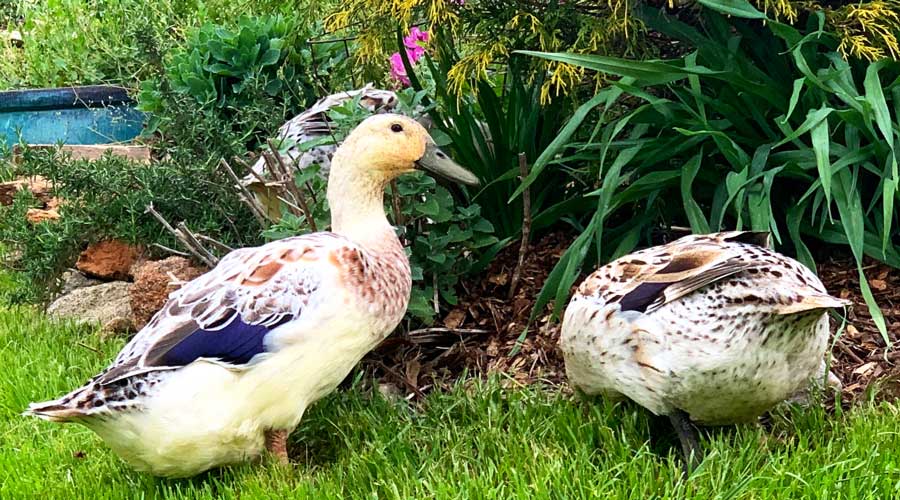
Once temperatures cross 90°F on a sunny summer day, our ducks’ location in our backyard is pretty easy to predict: they’re in one of their shady spots foraging or resting (assuming they’re not in their pond). Our backyard is well-appointed with shade provided from large oak trees and other smaller bushes like loropetalums, blueberries, persimmons, pomegranates, and more. Our ducks’ favorite shade plant is loropetalums, an attractive shrub in the witch hazel family. Oddly, they also enjoy eating the lower leaves of loropetalums, which creates a nice trimmed, open area underneath the plants. Ducks are not otherwise known for creating attractive landscapes. Ducks are not otherwise known for creating attractive landscapes.
3. Thoughtful coop and/or run positioning to provide shade.

4. Provide fresh, clean DRINKING water in no-tip bowls.

5. Provide vitamin & electrolyte supplements.
Speaking of drinking water… We also regularly add poultry-specific electrolyte supplements to our duck’s drinking water throughout the summer. The two brands we use and recommend are UltraCruz Poultry Electrolyte and Rooster Booster. These supplements can really give your ducks an extra boost on hot summer days.6. Provide clean, cool SWIMMING water, ideally in shade.

7. Provide healthy treats.
Providing nutrient-dense treats can be a big help on a summer day. Watermelon and cucumbers probably top the list of ideal summer treats to help your ducks combat heat stress. However, a caveat… You’d think animals that find raw slugs delectable would not be very picky eaters. Nevertheless, ducks can be surprisingly discerning. Since we’re connected to lots of other duck parents on social media, we used to watch enviously as their ducks wolfed down watermelons and frozen peas — treats our first flock of Welsh Harlequin ducks spurned. Then we added six rescue ducks of varying breeds to our flock, all of whom love watermelon, cucumbers, and peas. As our old ducks observed the new barbarian fowl eating these once-spurned treats, some of them decided watermelon, cucumbers, and peas weren’t so bad after all. Others continue to be picky eaters. Also, despite having a yard full of blackberries, raspberries, blueberries, and strawberries, none of our ducks seem to care for these fruits. An oft-repeated phrase in our household: “who’s to know the mind of a duck.” Two universal favorite treats in our flock:- fresh greens (specifically lettuce, kale, and chicory),
- tomatoes (cut into small pieces).
8. Electric fan
As you probably noticed, a windy hot day feels better than a breezeless hot day. A room with a ceiling fan feels cooler than a room without. Years back, we had a few days where the high temperatures hit 105°F for a few days in a row with high humidity and little breeze. In addition to other measures to help our ducks make it through, we got a large box fan for our ducks and placed it in front of one of their favorite shade areas. Needless to say, they loved it and spent quite a bit more time than usual in the spot basking in the breeze. Today, we put out a large oscillating fan anytime it’s over 90°F. The fan is directed towards their favorite backyard haunts during the day and towards their coop at night.9. Build a large coop for adequate spacing.
Do you and your special someone like to sleep outside on summer nights in down jackets while snuggling? Probably not. Likewise, your ducks need plenty of space inside their coop for comfort, hygiene, air circulation, and to reduce body-to-body heat transfer. As we detail in our article How to build a long-lasting predator-proof duck coop, a general rule when designing your duck coop is 2-6 square feet of space per duck inside their coop, with some variance based on breed size. Generally, the more space in your coop the better, both for your existing flock and for the future ducks you’ll get once your duck addiction kicks in.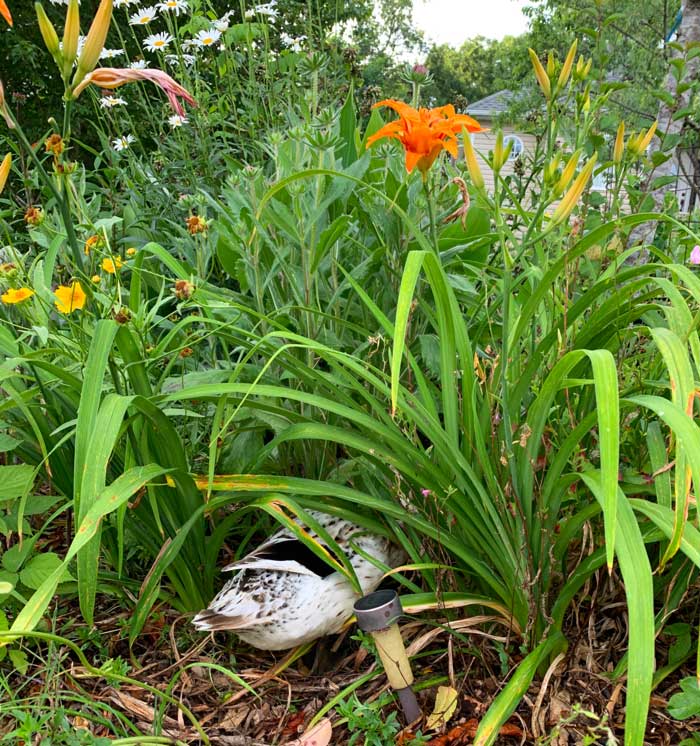
10. Well-ventilated coop
In addition to a large enough coop, it’s very important to make sure your coop is well-ventilated.
Frequently asked questions about summer duck maintenance
Here are answers to some other questions we get from duck parents pertaining to summer care:Question: My ducks are primarily indoor house ducks – do I need to worry about the difference in temperature when I put them outdoors?
If your duck(s) primarily live indoors with you in a climate controlled house, their bodies won’t be well-acclimated to the heat and humidity of outdoors in the summer. The same (but opposite) is true in the winter. When we were caring for a chronically ill pet duck who spent a lot of time indoors, we asked our avian vet about this issue. She told us that 30 degrees is about as much as we should push it when putting an indoor duck back outdoors in order to avoid potential health/respiratory problems. For indoor ducks, these temperature differentials are more of an issue in the winter than the summer given that most homes are kept around 70°F. Nevertheless, you do want to be really mindful and keep an eye on your indoor ducks if they’re let outdoors on really hot days when it’s over 90°F.Question: Wild ducks do just fine in the summer, so why wouldn’t my ducks be ok?
Ducks, like humans, have remarkably adaptive biological systems that allow them to acclimate to various environmental conditions. For instance, farm workers, roof installers, road pavers, etc. are able to survive because of complex physiological adaptations their bodies undergo due to continual exposure to extreme outdoor conditions… within limits. The same principle applies to wild and domesticated ducks: a healthy domesticated duck kept outdoors will acclimate to the environment. Some key differences:- Wild ducks can fly to a water source or easily find shade to cool down, e.g. seek out environments to help them adapt to specific weather conditions. Hopefully, your domesticated ducks can do the same (minus the flying).
- Domestic female ducks often lay hundreds of eggs per year, which puts an enormous tax on their bodies. This makes them more susceptible to nutrient deficiencies, plus reproductive and general health problems. .
Question: What’s normal? How do I know if my duck is heat stressed or needs an intervention/vet?
Like dogs and many other critters, ducks can’t sweat. However, you may notice them doing open-mouth panting when temperatures are really scorching. Their wings might even droop a little to help expel heat. These are normal temporary responses to heat exposure so long as they aren’t persistent. Also, if a duck exhibits the same signs of stress each day when the rest of your flock is acting normally, indoor TLC or a vet visit may be necessary. When in doubt, be proactive in providing care. To intervene with a heat-stressed duck, put your duck in a cool tub of water (outside in shade or indoors in an extra bathtub) and carefully monitor them to see if their behavior normalizes. Provide some favorite treats (like diced tomatoes and lettuce) to make the experience more enjoyable and try to get some electrolytes (see #5 above) into them. If they continue to show stress, a vet visit may be necessary.We hope this information helps you and your duck flock thrive this summer and for many summers to come! ~Aaron & Susan


More helpful articles that will quack you up:
- 17 tips to keep your ducks safe from predators
- How to build a long-lasting predator-proof duck coop and run
- What to feed ducks to maximize their health and longevity
- How to keep your ducks from destroying your lawn or garden
- How to make a DIY self-cleaning duck pond