All about henopause (poultry menopause)
Tyrant Farms' articles are created by real people with real experience. Our articles are free and supported by readers like you, which is why there are ads on our site. Please consider buying (or gifting) our books about raising ducks and raising geese. Also, when you buy through links on our site, we may earn an affiliate commission. Learn more
In this article, you’ll find out what “henopause” is and what to expect when your backyard ducks or other poultry go through henopause!
What is henopause?
In humans, we all know that menopause is a natural physiological process marking the end of a woman’s reproductive years. However, most people don’t know that birds can go through a similar physiological process…
We jokingly refer to this stage in our ducks’ life as “henopause.” Simply put, henopause occurs when a duck lives long enough to stop producing eggs.
Henopausal ducks also undergo complex hormonal changes that trigger some rather interesting and humorous physical changes as well, as detailed below.
Do all female birds go through henopause?
In the wild, female ducks may only live for a few years, so they don’t typically experience henopause. And commercial poultry raised for egg production are culled every 12-18 months, so they don’t experience henopause either.
Thus, outside of the backyard poultry community, you’re not likely to find many henopausal birds, which is probably why the condition is so little studied or discussed.
At what age does a duck undergo henopause?
We’ve been raising multiple breeds of ducks since 2013. From our anecdotal experiences, here’s what we’ve observed when it comes to henopause in ducks:
- A duck’s egg production peaks at about 18-24 months of age.
- After Year 2, you can expect a decline in total annual egg production.
- A healthy female duck who isn’t pushed for maximum egg production each year will continue laying some eggs up until about 6-8 years of age.
- The oldest duck we’ve ever had lay an egg is 9 years old.
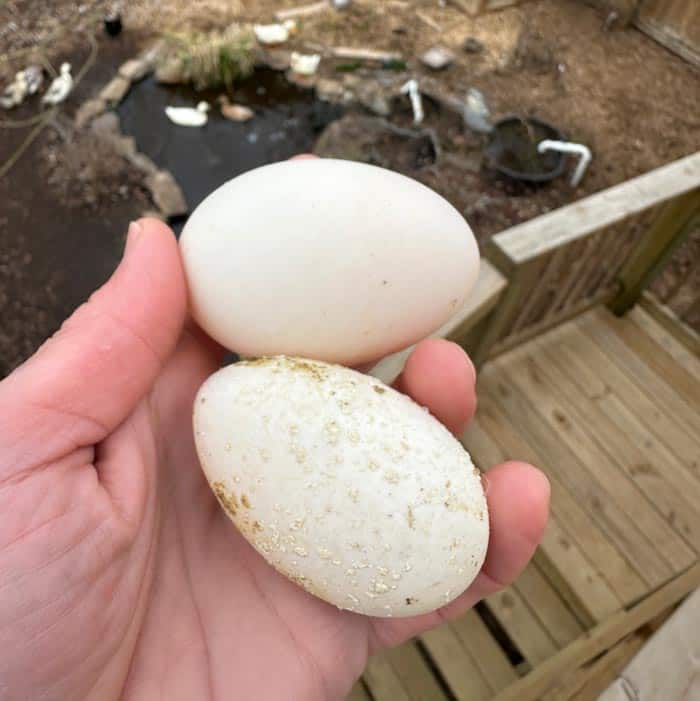
Exactly when a duck stops producing eggs and starts undergoing henopause is going to vary by individual duck based on some combination of genetics and environmental factors (which includes their care regimen). However, if you have ducks that are 8+ years old, there’s a pretty good chance they’re soon going to experience henopause.
Related: What to expect when your ducks age
Why and how does a bird run out of eggs?
Here’s an interesting fact many people don’t know: a female bird is born with all the “eggs” she could possibly lay in her lifetime. Technically, they’re not eggs, they’re “oocytes,” which are immature egg cell that may eventually go on to form an egg. A duck (or any bird for that matter) can not develop new oocytes after birth.
When conditions are right (10+ daylight hours, good nutrition, low stress, etc) a duck’s reproductive system will activate and oocytes will begin forming into eggs, even if there isn’t a drake around for fertilization. However, through a process called follicular atresia, many oocytes will simply die off without developing over the course of a duck’s lifespan. (The same general pattern is true in human females as well.)
Eventually, if a duck lives long enough, she will run out of oocytes and not be able to produce any more eggs. That’s when henopause starts.
What happens when a duck goes through henopause – what are the symptoms?
The first and most obvious symptom of henopause is that a duck will no longer produce eggs. However, if you’re new to the world of poultry, you might not realize that your ducks, chickens, etc should stop laying eggs for a significant percentage of the year.
Yes, we do everything we can to get our ducks to “turn off” egg production from fall through late winter. This break allows their bodies to recover from the physically demanding process of producing eggs, thus increasing their healthspan and lifespan. If you view your ducks as pets and bring them to the vet when they get sick or injured, this approach is quite sensible.
So when we say henopause starts when your duck stops laying eggs, we’re not referring to temporary seasonal cessation. Rather, we’re referring to when your duck permanently stops laying eggs.
Once that happens, things will start getting quite interesting…
Shifts in post-henopausal secondary sex characteristics
Primary sex characteristics refer to things like reproductive organs or chromosomes. Secondary sex characteristics refer to things like physical features, which vary by species and breed/type.
For instance, two very recognizable secondary sex characteristic in wild Mallard drakes when they’re in their nuptial plumage are:
- a vibrant green-colored head, and
- a curly “drake feather” just above their tail.
Unlike humans, the default sex in birds is male. This means that female ducks have to produce endogenous hormones which allow them to look like a female, otherwise they’d look like drakes by default. Likewise, if their bodies stop producing those hormones, they revert to the default sex’s secondary sex characteristics and begin to look more like males than females.
Now, can you guess what happens when a duck goes through henopause? Answer: Her body begins producing less and less of the hormones that “feminize” her appearance, and she’ll slowly start taking on male secondary sex features.
In sexually dymorphic duck breeds (aka those with distinct physical differences between males and females), your post-henopausal ducks will become visually identical to drakes of the same breed over the course of a few years. They’ll also begin acting much more like drakes, albeit less sexually aggressive.
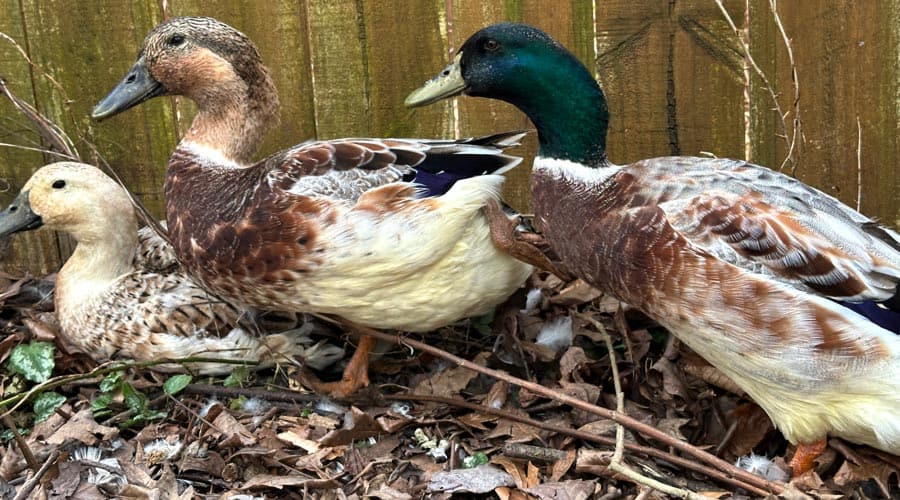
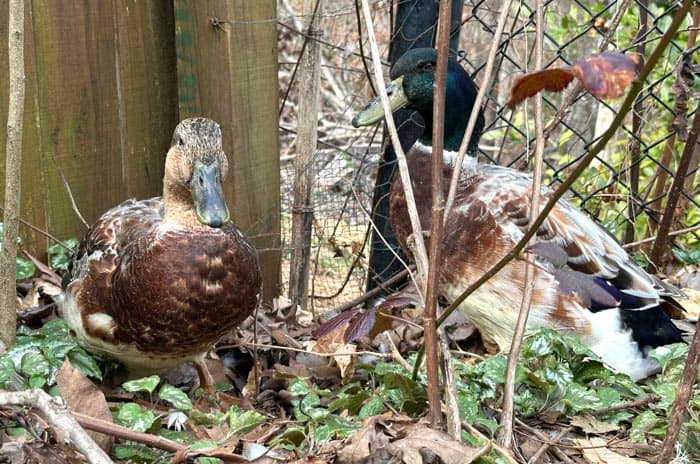
In our flock, we currently have one henopausal Welsh harlequin duck. (Her name is Poppy and she’s currently nine years old – we’re debating changing her name to Pappy.). Poppy stopped laying eggs last year.
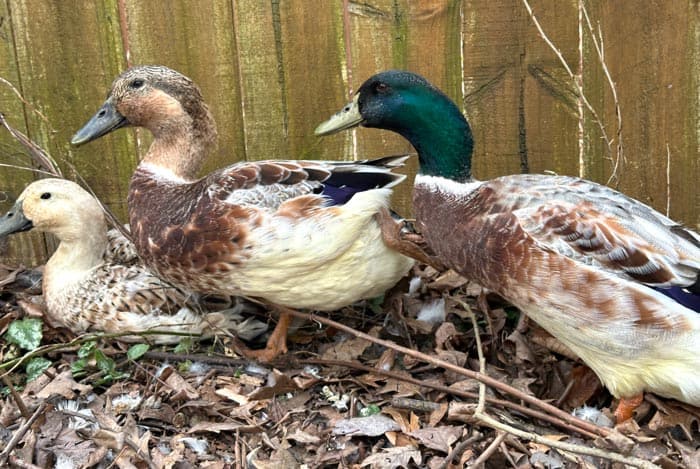
We also have the legendary Marty the duck (that’s MarTy with a “t”), who started off as Mary the duck. Marty’s story is very similar to henopause, but unique.
Marty had ovarian damage due to over-producing eggs during her third year, which shut off her reproductive system. Now, she looks like the most beautiful drake in the world, seems to think she’s a drake, and spends her days trying to kill our actual drake through fencing we use to keep them separated.
While Marty and our henopausal duck still vocalize like girls, we’ve heard from LOTS of chicken keepers who have henopausal chickens that began crowing and acting like roosters.
Nature always has a surprise in store!
How long can a duck live after henopause?
How long a duck lives after henopause is likely to vary greatly by individual duck and the quality of care they receive. Poppy doesn’t have the same pep as our young ducks, which could be purely age-related. However, she still has a high quality of life. Marty the Duck has been in full drake-mode for about 5 years now and she’s still going strong, although she’s also slowed down considerably from her younger years.
If you have henopausal poultry in your flock, please drop a comment below to share your story!


Be sure to check out the latest duck articles from Tyrant Farms!


Hi Guys! I love your posts. We have a single hen that has never seen another duck before and we are her family. She spends the evenings with us inside and loves her area of puppy pads and a little blanket hideaway. She is paper trained but is allowed to explore our small cabin looking for the cat or the ‘Dad’. She is not enclosed around the house. For sleeping she stands by her raised rabbit hutch beside the kitchen for her evening meal of lettuce, grapes, blueberries, peas or corn. At least 3 choices. She started out eating Science Diet dry cat food (I know, too much protien) so she has free access to that and water at all times.
She’s a 9 and a half yr old orppington buff that still lays about 2 dozen eggs from June thru Aug but last week she laid an egg 2 days in a row after not laying for a month. Should we be worried? Sleeps A LOT but still forages and loves her pool. Also she’s still ‘laying flat’ by my feet and gives my ankles little bites. Isn’t she too old to still be thinking I’m also her boyfriend?
We in Orange Co CA and it’s been a HOT summer, still. What is the oldest duck you’ve ever had and was it in good/fair health up until the end?
Thanks for everything you both do!
Jenny Scott [email protected]
Hi Jenny! What an interesting little duck you have there. It doesn’t sound like you have anything to worry about. The older duck hens get, the less and more unpredictable their laying becomes. Also, every duck will be different. For instance, we have four Welsh harlequin hens who were all born within one week of each other about 10 and a half years ago. Two of them are well into henopause; one laid a couple eggs this spring and her coloration indicates she’s now just starting to enter henopause; and the fourth is still “frisky” and laying maybe one egg per week. As long as your duck isn’t laying soft-shelled eggs or showing any signs of physiological distress, there’s probably nothing to worry about. The oldest duck we’ve ever had was 11, but we’ve heard of ducks living to be about 20 years old. She died of cancer – she seemed normal until about one week before her death, then she declined quickly until we had her put down by our vet.
We had a female Rouen go through Henopause when she was 12 years old. That is when she stopped laying eggs. She lived to be 18 years old! And yes, she changed her look. Green head etc., like a male Rouen. Her name was Mabel.
Fascinating! And good on Mabel for making it to the ripe old age of 18. We’ve heard from lots of other poultry owners who’ve had similar experiences.
We had a female Rouen go through Henopause when she was 12 years old. That is when she stopped laying eggs. She lived to be 18 years old! And yes, she changed her look. Green head etc., like a male Rouen. Her name was Mabel.
Fascinating! And good on Mabel for making it to the ripe old age of 18. We’ve heard from lots of other poultry owners who’ve had similar experiences.
We had a female Rouen go through Henopause when she was 12 years old. That is when she stopped laying eggs. She lived to be 18 years old! And yes, she changed her look. Green head etc., like a male Rouen. Her name was Mabel.
Fascinating! And good on Mabel for making it to the ripe old age of 18. We’ve heard from lots of other poultry owners who’ve had similar experiences.